The British Rail Class 221 Super Voyager is a class of tilting diesel-electric multiple unit express passenger trains built in Bruges, Belgium and Wakefield, by Bombardier Transportation in 2001–02.
CrossCountry Class 221 at Leamington Spa in 2015
Standard Class interior on a refurbished Avanti West Coast unit
Classes 220 (left) and 221 (right) showing the differing bogie designs
The first class interior on a CrossCountry Class 221
A tilting train is a train that has a mechanism enabling increased speed on regular rail tracks. As a train rounds a curve at speed, objects inside the train experience centrifugal force. This can cause packages to slide about or seated passengers to feel squashed by the outboard armrest, and standing passengers to lose their balance, or in such excessive speeds, could even cause the train to derail. Tilting trains are designed to counteract this by tilting the carriages towards the inside of the curve, thus compensating for the g-force. The train may be constructed such that inertial forces cause the tilting, or it may have a computer-controlled powered mechanism.
A Japanese KiHa 283 series tilting DMU, which can tilt up to 8° (6° in normal operation)
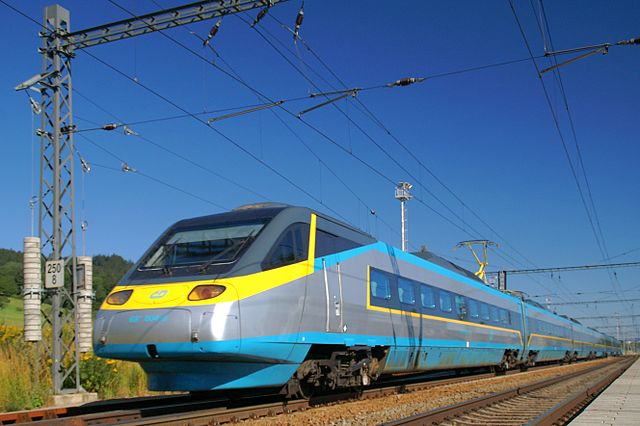
A ČD Class 680 Pendolino train in July 2006
A Swiss SBB RABDe 500 on the Hauenstein railway line in May 2007
An ICE T (DB class 411) leaves a curve, showing cars tilted to different degrees.