Algorithm
Videos
In mathematics and computer science, an algorithm is a finite sequence of mathematically rigorous logical instructions, typically used to solve a class of specific problems or to perform a computation
Muḥammad ibn Mūsā al-Khwārizmī: The 9th-century mathematician whose name is the origin of the word 'algorithm'.


Ada Lovelace's diagram from "Note G", the first published computer algorithm
Turing machine
Videos
A Turing machine is a mathematical model of computation describing an abstract machine that manipulates symbols on a strip of tape according to a table of rules. Despite the model's simplicity, it is
Algorithm
…Gödel–Herbrand–Kleene recursive functions of 1930, 1934 and 1935, Alonzo Church's lambda calculus of 1936, Emil Post's Formulation 1 of 1936, and Alan Turing's Turing machines of 1936–37 and 1939. The mathematical formalization of the notion of algorithm is distinct from the formalization of computable functions. In particular…

A physical Turing machine model constructed by Mike Davey. A true Turing machine would need to be provided more memory (tape) if and when required; physical models can only have a finite amount.
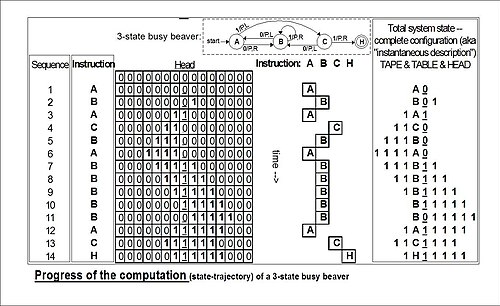
The evolution of the busy beaver's computation starts at the top and proceeds to the bottom.

An implementation of a Turing machine

A Turing machine realization using Lego pieces