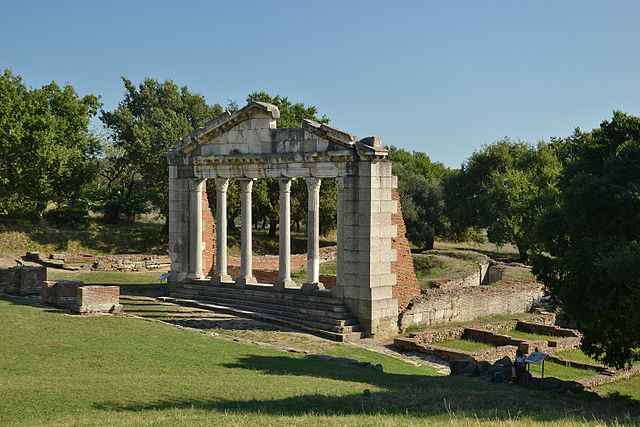
Apollonia was an Ancient Greek trade colony which developed into an independent polis, and later a Roman city, in southern Illyria. It was located on the right bank of the Aoös/Vjosë river, approximately 10 km from the eastern coast of the Adriatic Sea. Its ruins are situated in the county of Fier, close to the village of Pojan, in Albania.
The "Monument to Agonothetes" was built in the 2nd century BC and functioned as Apollonia's municipal council meeting building in the Roman era
A 4th-3rd century BC silver stater from Apollonia bearing the inscription ΑΠΟΛ.
Apollonia was strategically located at the beginning of one of the two starting branches of the Via Egnatia in Illyria. Retracing a prehistoric trade route that linked the eastern Adriatic coast with eastern Thrace, the road permitted overland travel elsewhere in the region, and it was the principal land route from Rome to the east.
Capital of Monument of Agonothetes
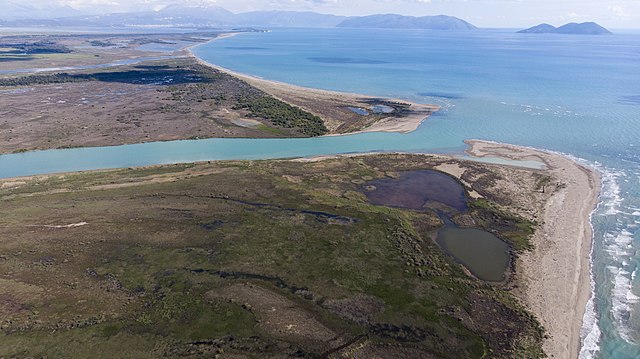
The Vjosa or Aoös is a river in northwestern Greece and southwestern Albania. Its total length is about 272 kilometres (169 mi), of which the first 80 kilometres (50 mi) are in Greece, and the remaining 192 kilometres (119 mi) in Albania. Its drainage basin is 6,706 km2 (2,589 sq mi) and its average discharge is 195 m3/s (6,900 cu ft/s). The main tributaries are Voidomatis, Sarantaporos, Drino and Shushicë.
Mouth of Vjosa discharging into the Adriatic
Image: Vjosa River by NASA's Earth Observatory (2022)
View towards the Vjosa valley from Byllis, the chief city and one of the two centres of the Illyrian koinon of the Bylliones.
The personification of Vjosa River. Found in Apollonia