Arawa (canoe)
Videos
Arawa was one of the great ocean-going, voyaging canoes in Māori traditions that was used in the migrations that settled New Zealand. The Te Arawa confederation of Māori iwi and hapū based around the

Te Aurere, a modern reconstruction of a sea-going waka (canoe).

Pōhutukawa trees in flower

Kennett Watkin's 1912 painting, The Legend of the Voyage to New Zealand, depicts the landfall of migratory canoes, including the Arawa, at Whangaparāoa

Centennial monument, Maketu.
Raʻiātea
Videos
Raʻiātea or Raiatea is the second largest of the Society Islands, after Tahiti, in French Polynesia, in the South Pacific Ocean. The island is widely regarded as the "centre" of the eastern islands in
Arawa (canoe)
…based around Lake Taupō, trace their ancestry from the people of this canoe. Te Arawa's ancestors on board the Arawa were of the Ngāti Ohomairangi of Ra'iātea Island. Following a battle that broke out between them and Uenuku, in which their own Whakatūria fell in battle, Tama-te-kapua promised to captain the voyage…
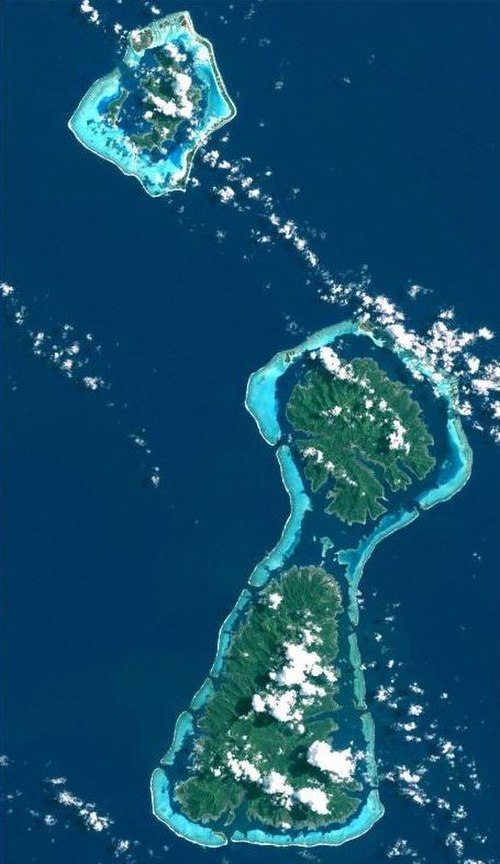
The islands of Bora Bora (top) Tahaa (middle) and Raiatea (bottom). Tahaa and Raiatea share the same lagoon.

Taputapuatea marae, an ancient marae mentioned in the traditions of Polynesian peoples, including, for example, the Māori of Aotearoa. This is where the Hawaiian voyaging canoe Hōkūle'a landed on its first voyage in 1976.

The Royal Family of Raiatea in the 1880s, when Raiatea became a French Protectorate. In the background, holding the flag, is Teraupo.

Aerial view of the island