Creep (deformation)
Videos
In materials science, creep is the tendency of a solid material to undergo slow deformation while subject to persistent mechanical stresses. It can occur as a result of long-term exposure to high leve

The movement of ice in a glacier is an example of creeping in solids

Creep on the underside of a cardboard box: a largely empty box was placed on a smaller box, and more boxes were placed on top of it. Due to the weight, the portions of the empty box not upheld by the lower support gradually deflected downward
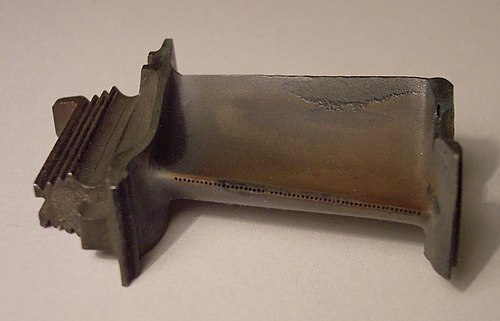
Materials operating at high temperatures, such as this nickel superalloy jet engine (RB199) turbine blade, must be able to withstand creep present at these temperatures.
Viscoelasticity
Videos
Viscoelasticity is a material property that combines both viscous and elastic characteristics. Many materials have such viscoelastic properties, especially materials that consist of large molecules. P
Creep (deformation)
…coefficient, and Q is the diffusion activation energy: A = A ′ D 0 μ b k T exp ( − Q k T ) Creep can occur in polymers and metals which are considered viscoelastic materials. When a polymeric material is subjected to an abrupt force, the response can be modeled using the Kelvin–Voigt model. In this model, the…

Temperature dependence of modulus

Elastic v. viscoelastic material