Requin was an ironclad barbette ship built for the French Navy in the late 1870s and early 1880s. She was last member of the four-ship Terrible class. They were built as part of a fleet plan started in 1872, which by the late 1870s had been directed against a strengthening Italian fleet. The ships were intended for coastal operations, and as such had a shallow draft and a low freeboard, which greatly hampered their seakeeping and thus reduced their ability to be usefully employed outside of coastal operations after entering service. Armament consisted of a pair of 420 mm (16.5 in) guns in individual barbettes, the largest-caliber gun ever mounted on a French capital ship. Requin was laid down in 1878 and was completed in 1887.
Requin in Britain in 1892
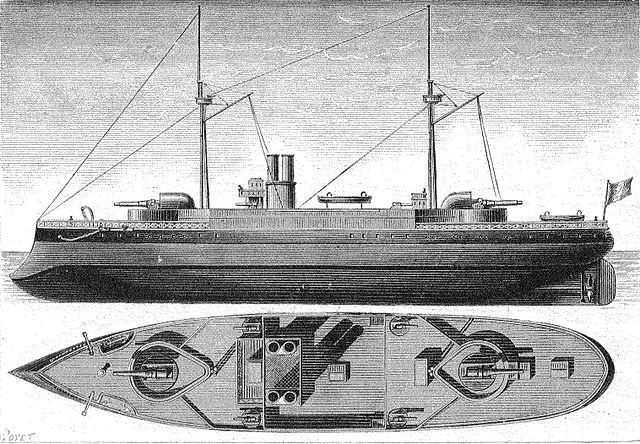
Sketch showing the side and top views of the class
Requin in Britain in 1891
Line-drawing of the Terrible class after refit
The Terrible class was a group of four ironclad barbette ships built for the French Navy in the late 1870s and early 1880s. The class consisted of Terrible, Indomptable, Caïman, and Requin, and is sometimes referred to as the Indomptable class. They were built as part of a fleet plan started in 1872 after the Franco-Prussian War and were designed in response to the German Sachsen class of barbette ships. The Terribles were scaled down versions of the Amiral Baudin class, with one less main gun, though they were of significantly larger caliber. Because the ships were intended for operations against the German fleet in the shallow Baltic Sea, they had a low draft and freeboard, which greatly hampered their seakeeping and thus reduced their ability to be usefully employed after entering service. Armament consisted of a pair of 420 mm (16.5 in) guns in individual barbettes, which were the largest guns ever mounted on a French capital ship.
Requin in Britain in 1892
The Sachsen class prompted the Terrible design
Sketch showing the side and top views of the class
Sketch of Caïman