Iris (mythology)
Videos
In ancient Greek religion and mythology, Iris is a daughter of the gods Thaumas and Electra, and the personification of the rainbow. She functions as a messenger and servant to the Olympians, particul
Iris, Attic lekythos in Six's technique (superposed colours), circa 500–490 BC, found in Tanagra, now in Louvre.


Winged female figure holding a caduceus: Iris (messenger of the gods) or Nike (Victory)
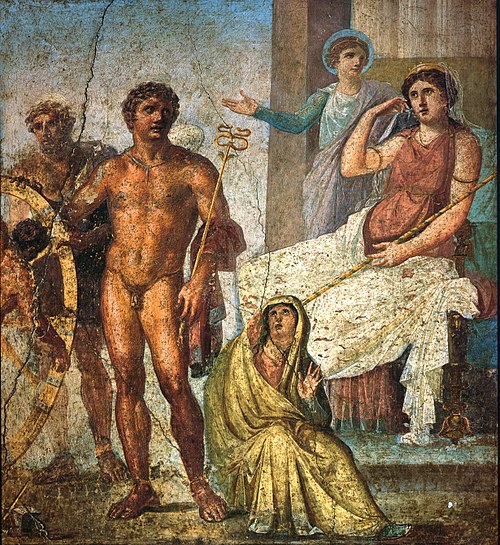
Iris stands behind the seated Juno (right) in a Pompeii fresco

Iris Carrying the Water of the River Styx to Olympus for the Gods to Swear By, by Guy Head (c. 1793)
Zephyrus
Videos
In Greek mythology and religion, Zephyrus, also spelled in English as Zephyr, is the god and personification of the West wind, one of the several wind gods, the Anemoi. The son of Eos and Astraeus, Ze
Iris (mythology)
…personification of the rainbow. She functions as a messenger and servant to the Olympians, particularly Hera. Iris was traditionally seen as the consort of Zephyrus, the god of the west wind and one of the four Anemoi, by whom she is the mother of Pothos in some texts. While Iris appears in several stories running…

Zephyrus on an antique fresco in Pompeii

Zephyr and Flora, c. 1720, by Antonio Corradini, Victoria and Albert Museum.

Zephyrus with Chloris in Primavera by Sandro Botticelli, ca. 1470s–1480s, oil on canvas.

Zephyrus relief from the Tower of the Winds, Athens.