Khan (title)
Videos
Khan is a historic Turkic and Mongolic title originating among nomadic tribes in the Central and Eastern Eurasian Steppe to refer to a king. It first appears among the Rouran and then the Göktürks as

Eurasia on the eve of the Mongol invasions, c. 1200 AD

Mongol Empire's largest extent outlined in red; the Timurid Empire is shaded.
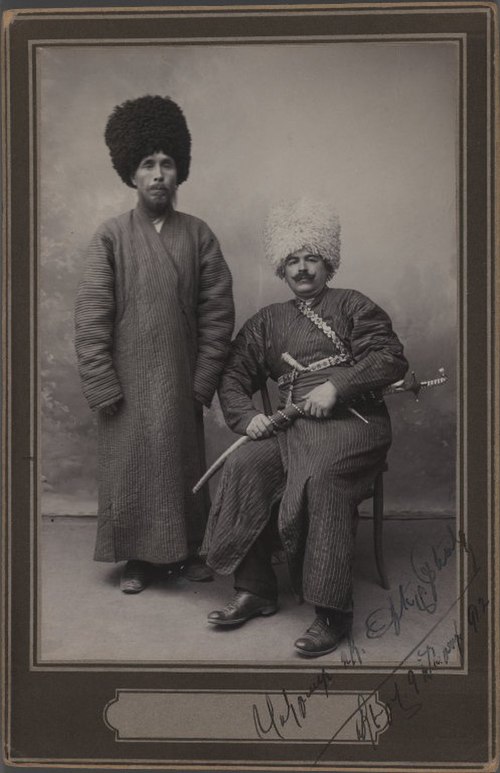
Two Khans in Turkoman Tribal Costume, One of 274 Vintage Photographs. Brooklyn Museum.
Ögedei Khan
Videos
Ögedei Khan was the second khan of the Mongol Empire. The third son of Genghis Khan, he continued the expansion of the empire that his father had begun.
Khan (title)
…Empire starting from 1229. Genghis Khan himself was referred as qa'an (khagan) only posthumously. For instance Möngke Khan (reigned 1251–1259) and Ogedei Khan (reigned 1229–1241) would be "Khagans" but not Chagatai Khan, who was not proclaimed ruler of the Mongol Empire by the Kurultai. Originally khans headed…

Ögedei Khan portrayed in a 14th-century Yuan-era album, originally painted in 1278 (National Palace Museum, Taipei)

Statue of Ögedei Khan in Sükhbaatar Square, Ulaanbaatar. Together with Kublai Khan's, and the much larger Genghis Khan's statues, it forms a statue complex dedicated to the Mongol Empire.

Coronation of Ögedei in 1229, by Rashid al-Din, early 14th century

Detail of miniature from the Illustrated Chronicle of Ivan the Terrible depicting the Mongols capturing a city (16th century)