Mare Acidalium quadrangle
The Mare Acidalium quadrangle is one of a series of 30 quadrangle maps of Mars used by the United States Geological Survey (USGS) Astrogeology Research Program. The quadrangle is located in the northeastern portion of Mars' western hemisphere and covers 300° to 360° east longitude and 30° to 65° north latitude. The quadrangle uses a Lambert conformal conic projection at a nominal scale of 1:5,000,000 (1:5M). The Mare Acidalium quadrangle is also referred to as MC-4.
Image of the Mare Acidalium quadrangle (MC-4). The large craters Lomonosov (far upper right) and Kunowsky (upper right) are easily seen. The famous "face" on Mars is located in the Cydonia Mensae area (bottom right).
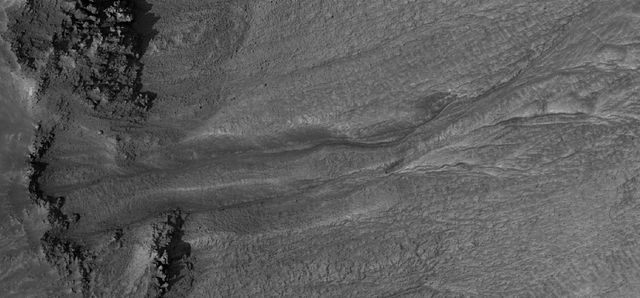
Gullies on crater wall The bright apron is a bit unusual.
Gully on crater wall The bright apron is a bit unusual.
Acidalia Colles Gullies and other features, as seen by HiRISE. The scale bar is 1,000 meters long.
Acidalia Planitia is a plain on Mars, between the Tharsis volcanic province and Arabia Terra to the north of Valles Marineris, centered at 49.8°N 339.3°E. Most of this region is found in the Mare Acidalium quadrangle, but a small part is in the Ismenius Lacus quadrangle. The plain contains the famous Cydonia region at the contact with the heavily cratered highland terrain.
A gully found in the Bamberg Crater, which resides in Acidalia Planitia
Possible mud volcano in Acidalia Planitia