Premnas biaculeatus, commonly known as spine-cheeked anemonefish or the maroon clownfish, is a species of anemonefish found in the Indo-Pacific from western Indonesia to Taiwan and the Great Barrier Reef. They can grow up to be about 17 cm (6.7 in). Like all anemonefishes it forms a symbiotic mutualism with sea anemones and is unaffected by the stinging tentacles of the host anemone. It is a sequential hermaphrodite with a strict size-based dominance hierarchy; the female is largest, the breeding male is second largest, and the male nonbreeders get progressively smaller as the hierarchy descends. They exhibit protandry, meaning the breeding male changes to female if the sole breeding female dies, with the largest nonbreeder becoming the breeding male. The fish's natural diet includes algae and zooplankton.
Maroon clownfish
Female from Gilli Lawa Laut, near Komodo Island showing the gold tinged head bar and distinctive cheek spine
Male at Bunaken island, North Sulawesi, showing the bright red-orange colors and three white body bars
Female at Bunaken island, North Sulawesi, showing the dull-yellow head bar and grey body bars
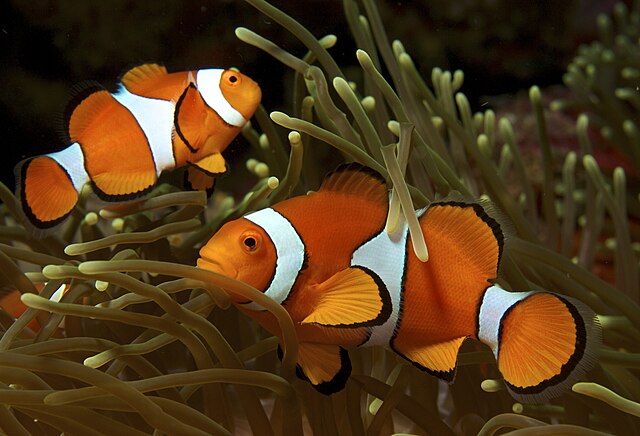
Clownfish or anemonefish are fishes from the subfamily Amphiprioninae in the family Pomacentridae. Thirty species of clownfish are recognized: one in the genus Premnas, while the remaining are in the genus Amphiprion. In the wild, they all form symbiotic mutualisms with sea anemones. Depending on the species, anemonefish are overall yellow, orange, or a reddish or blackish color, and many show white bars or patches. The largest can reach a length of 17 cm, while the smallest barely achieve 7–8 cm.
Clownfish
Ocellaris clownfish nestled in a magnificent sea anemone (Heteractis magnifica)
A pair of pink anemonefish (Amphiprion perideraion) in their anemone home
Image: Amphiprion akallopisos 13376076