Natural History (Pliny)
Videos
The Natural History is a Latin work by Pliny the Elder. The largest single work to have survived from the Roman Empire to the modern day, the Natural History compiles information gleaned from other an
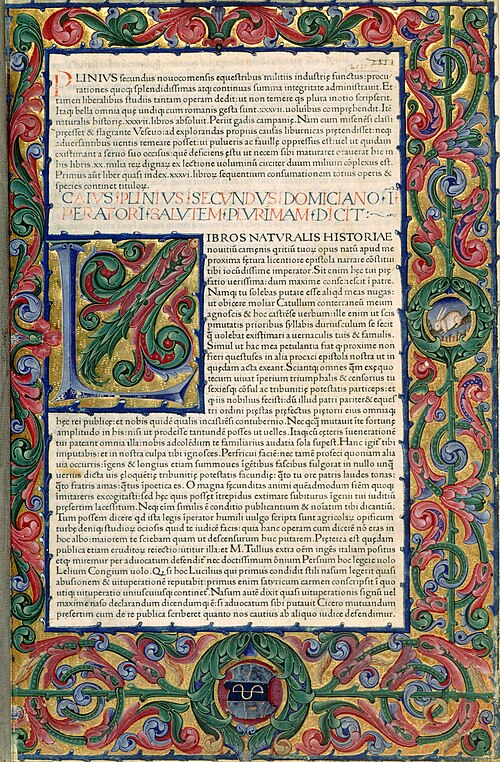
First page from the editio princeps of the Naturalis historia, printed in 1469 in Venice by Johann of Speyer. Bibliothèque nationale de France.

Copy of Naturalis Historia printed by Johannes Alvisius in 1499 in Venice, Italy

A cynocephalus, or dog-head, as described by Pliny in his Natural History. From the Nuremberg Chronicle (1493).

A sciapod, described by Pliny in his Natural History, from the Nuremberg Chronicle (1493)
Pliny the Younger
Videos
Gaius Plinius Caecilius Secundus, better known in English as Pliny the Younger, was a lawyer, author, and magistrate of Ancient Rome. Pliny's uncle, Pliny the Elder, helped raise and educate him.
Natural History (Pliny)
…final revision of the remainder at the time of his death during the AD 79 eruption of Vesuvius. The rest was published posthumously by Pliny's nephew, Pliny the Younger. The work is divided into 37 books, organised into 10 volumes. These cover topics including astronomy, mathematics, geography, ethnography, anthropology…

Detail from Pliny the Younger and His Mother at Miseno by Angelica Kauffman, 1785

View of Bellagio in Lake Como. The institution on the hill is Villa Serbelloni, believed to have been constructed on the site of Pliny's villa "Tragedy."