Plasma (physics)
Videos
Plasma is a state of matter that results from one of the other three classical states having undergone an appreciable degree of ionization. It thus consists of a significant portion of charged particl

Lightning as an example of plasma present at Earth's surface: Typically, lightning discharges 30 kiloamperes at up to 100 megavolts, and emits radio waves, light, X- and even gamma rays. Plasma temperatures can approach 30000 K and electron densities may exceed 1024 m−3.

Artificial plasma produced in air by a Jacob's Ladder

Hall-effect thruster

Plasma spraying
Sun
Videos
The Sun is the star located at the centre of the Solar System. It is a massive sphere of hot plasma, heated to incandescence by nuclear fusion reactions in its core, radiating the energy from its surf
Plasma (physics)
…atmosphere, as seen from the International Space Station. Bottom left: A fire in a fire pit; fires may produce plasma if hot enough. Bottom right: The Sun's corona as seen from a solar eclipse. Plasma is a state of matter that results from one of the other three classical states (often, the gaseous one…
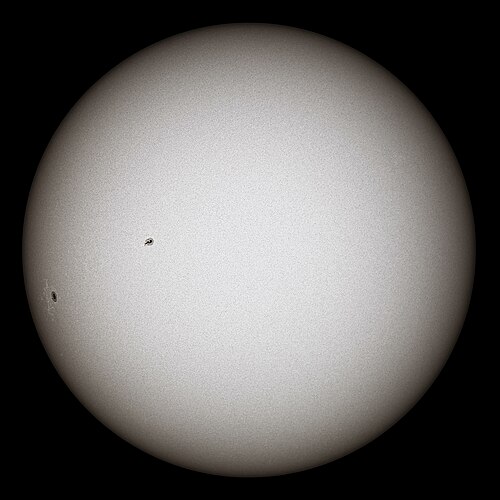
The Sun as viewed through a clear solar filter

The photosphere is structured by convection cells referred to as granules.

The Sun's transition region taken by Hinode's Solar Optical Telescope

During a total solar eclipse the solar corona can be seen with the naked eye.