Polish People's Republic
Videos
The Polish People's Republic, formerly the Republic of Poland, was the Polish state that existed as the predecessor of the modern-day electoral Third Polish Republic. With a population of approximatel

Poland's fate was heavily discussed at the Yalta Conference in February 1945. Joseph Stalin, whose Red Army occupied the entire country, imposed a puppet communist government, thus forcibly bringing Poland into the Soviet sphere of influence.
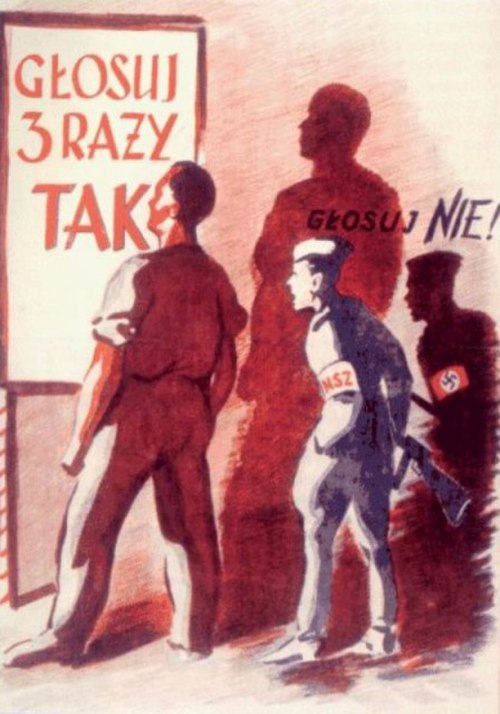
A propaganda poster encouraging a vote for Communist policies in the "Three Times Yes" 1946 referendum

Draft of Constitution of the Polish People's Republic (Russian version) with Stalin's remarks, 1952

The 1970 Polish protests were put down by the communist authorities and Milicja Obywatelska. The riots resulted in the deaths of 42 people and over 1,000 injuries.
Warsaw Pact
Videos
The Warsaw Pact, formally the Treaty of Friendship, Cooperation and Mutual Assistance, was a collective defence treaty signed in Warsaw, Poland, between the Soviet Union and seven other Eastern Bloc s
Polish People's Republic
…37.9 million near the end of its existence, it was the second most populous communist and Eastern Bloc country in Europe. It was also where the Warsaw Pact was founded. The largest city and capital was Warsaw, followed by the industrial city of Łódź and cultural capital of Kraków. The country was bordered…

The Presidential Palace in Warsaw, Poland, where the Warsaw Pact was established and signed on 14 May 1955.

Conference during which the Pact was established and signed.

A typical Soviet military vehicle UAZ-469, used by most countries of the Warsaw Pact

Meeting of the seven representatives of the Warsaw Pact countries in East Berlin in May 1987. From left to right: Gustáv Husák (Czechoslovakia), Todor Zhivkov (Bulgaria), Erich Honecker (East Germany), Mikhail Gorbachev (Soviet Union), Nicolae Ceaușescu (Romania), Wojciech Jaruzelski (Poland), and János Kádár (Hungary)