President's House in Philadelphia was the third U.S. presidential mansion, following the first two in New York City. President George Washington occupied the Philadelphia house from November 27, 1790
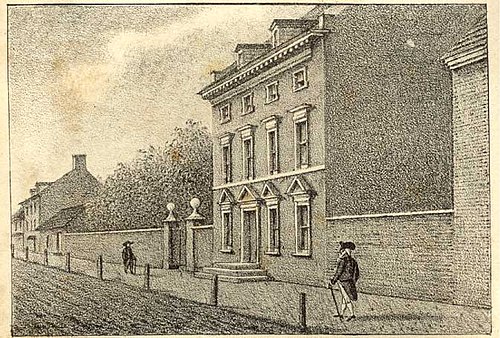
An 1830 lithograph of the President's House in Philadelphia. This served as the U.S. Executive Mansion for President George Washington from November 1790 to March 1797, and for President John Adams from March 1797 to May 1800.

The Washington Family, a painting by Edward Savage completed between 1789 and 1796, depicting (left to right): George Washington Parke Custis, George Washington, Nelly Custis, Martha Washington, and an enslaved servant, probably William Lee or Christopher Sheels

A 1796 runaway advertisement for Oney Judge, one of nine slaves held by Washington at President's House in Philadelphia

The icehouse pit, which was excavated in December 2000 and reburied beneath the Liberty Bell Center
Independence National Historical Park is a federally protected historic district in Philadelphia, Pennsylvania, that preserves several sites associated with the American Revolution and the nation's fo
President's House (Philadelphia)
…1951, confusion over the exact location of the Philadelphia President's House led to its surviving walls being unknowingly demolished for what is now Independence Mall. Advocacy by historians and African American groups resulted in the 2010 commemoration of the site as a memorial to the nine slaves in Washington's…

The Liberty Bell (foreground) and Independence Hall (background) at Independence National Historical Park

Scene at the Signing of the Constitution of the United States, a 1940 portrait by Howard Chandler Christy

Independence Hall, the iconic Philadelphia building where the Founding Fathers unanimously adopted the U.S. Declaration of Independence and appointed George Washington as commander of the Continental Army in a bold but risky effort to secure independence from Britain's colonial governance