Activated carbon
Videos
Activated carbon, also called activated charcoal, is a form of carbon commonly used to filter contaminants from water and air, among many other uses. It is processed to have small, low-volume pores th
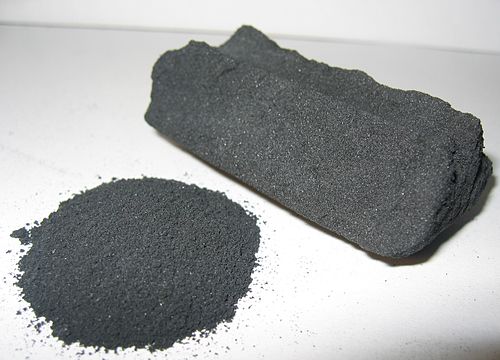
Activated carbon

Activated charcoal for medical use

A micrograph of activated charcoal (R 1) under bright field illumination on a light microscope. Notice the fractal-like shape of the particles hinting at their enormous surface area. Each particle in this image, despite being only around 0.1 mm across, can have a surface area of several square centimetres. The entire image covers a region of approximately 1.1 by 0.7 mm, and the full resolution version is at a scale of 6.236 pixels/μm.

A micrograph of activated charcoal (GAC) under a scanning electron microscope
Adsorption
Videos
Adsorption is the adhesion of atoms, ions, or molecules from a gas, liquid, or dissolved solid to a surface. This process creates a film of the adsorbate on the surface of the adsorbent. This process
Activated carbon
…water and air, among many other uses. It is processed (activated) to have small, low-volume pores that greatly increase the surface area available for adsorption or chemical reactions. (Adsorption, not to be confused with absorption, is a process where atoms or molecules adhere to a surface). The pores can be…

Activated carbon nitrogen isotherm showing a marked microporous type I behavior

Silica gel adsorber for NO2, Fixed Nitrogen Research Laboratory, ca. 1930s