Croesus
Videos
Croesus was the king of Lydia, who reigned from 585 BC until his defeat by the Persian king Cyrus the Great in 547 or 546 BC. According to Herodotus, he reigned 14 years. Croesus was renowned for his wealth; Herodotus and Pausanias noted that his gifts were preserved at Delphi. The fall of Croesus had a profound effect on the Greeks, providing a fixed point in their calendar. "By the fifth century at least", J. A. S. Evans has remarked, "Croesus had become a figure of myth, who stood outside the conventional restraints of chronology."

Depiction of Croesus, Attic red-figure amphora, painted c. 500–490 BC

Gold coin of Croesus, Lydian, around 550 BC, found in what is now modern Turkey
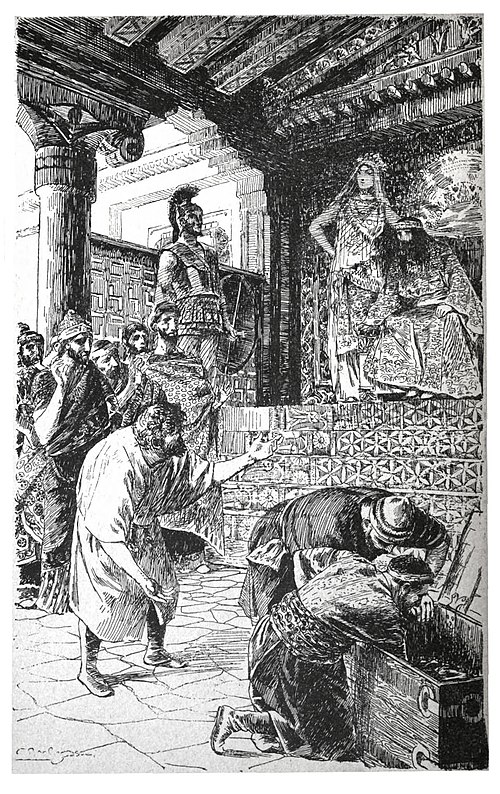
Aesop in front of Croesus

Croesus showing his treasures to Solon. Frans Francken the Younger, 17th century
Temple of Artemis
Videos
The Temple of Artemis or Artemision, also known as the Temple of Diana, was a Greek temple dedicated to an ancient, localised form of the goddess Artemis. It was located in Ephesus. By AD 401 it had been ruined or destroyed. Only foundations and fragments of the last temple remain at the site.
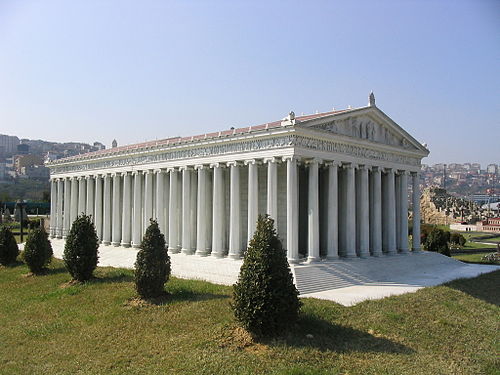
This model of the Temple of Artemis, at Miniatürk Park, Istanbul, Turkey, attempts to recreate the probable appearance of the third temple.

The site of the temple in 2017

The fame of the Temple of Artemis was known in the Renaissance, as demonstrated in this imagined portrayal of the temple in a 16th-century hand-colored engraving by Martin Heemskerck.

Electrotype of electrum coin from Ephesus, 625–600 BC. Stag grazing right, ΦΑΕΝΟΣ ΕΜΙ ΣΕΜΑ (retrograde, "I am the badge of Phanes").