Nicolas Poussin
Videos
Nicolas Poussin was a French painter who was a leading painter of the classical French Baroque style, although he spent most of his working life in Rome. Most of his works were on religious and mythological subjects painted for a small group of Italian and French collectors. He returned to Paris for a brief period to serve as First Painter to the King under Louis XIII and Cardinal Richelieu, but soon returned to Rome and resumed his more traditional themes. In his later years he gave growing prominence to the landscape in his paintings. His work is characterized by clarity, logic, and order, and favors line over color. Until the 20th century he remained a major inspiration for such classically-oriented artists as Jacques-Louis David, Jean-Auguste-Dominique Ingres and Paul Cézanne.


Death of Germanicus, 1628, Minneapolis Institute of Art

Venus and Adonis, c. 1628–1629, Kimbell Art Museum

The Inspiration of the Poet, 1629–30, Louvre
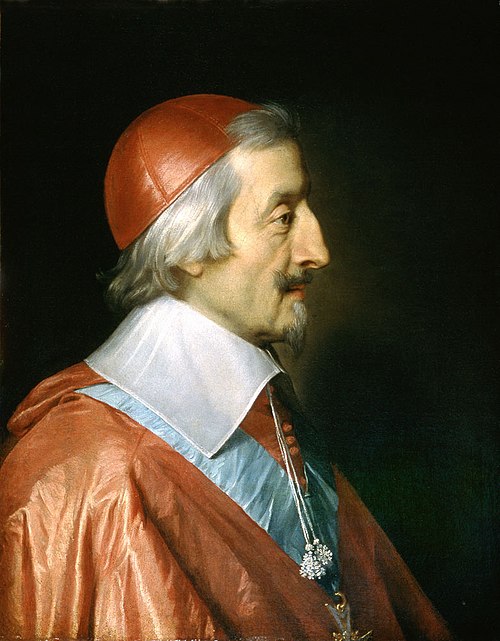
Cardinal Richelieu
Videos
Armand Jean du Plessis, 1st Duke of Richelieu, known as Cardinal Richelieu, was a French statesman and prelate of the Catholic Church. He became known as l'Éminence Rouge, or "the Red Eminence", a term derived from the title "Eminence" applied to cardinals and from the red robes that they customarily wear.

The young Louis XIII; only a figurehead during his early reign; power actually rested with his mother Marie de' Medici.

Jean Warin, Cardinal de Richelieu 1622 (obverse), 1631

On the "Day of the Dupes" in 1630, it appeared that Marie de Médicis had secured Richelieu's dismissal. Richelieu, however, survived the scheme, and Marie was exiled as a result.