Northwest Semitic languages
Videos
Northwest Semitic is a division of the Semitic languages comprising the indigenous languages of the Levant. It emerged from Proto-Semitic in the Early Bronze Age. It is first attested in proper names identified as Amorite in the Middle Bronze Age. The oldest coherent texts are in Ugaritic, dating to the Late Bronze Age, which by the time of the Bronze Age collapse are joined by Old Aramaic, and by the Iron Age by Sutean and the Canaanite languages.

Aramaic alphabets

Phoenician alphabets

Charles Morton's 1759 updated version of Edward Bernard's "Orbis eruditi", comparing all known alphabets as of 1689, including Northwest Semitic which is described as "Adami, Noachi, Nini, Abrahami, Phoenicum et Samaritarum ante Christe (5509) a nummis Iudaicis Africanisque Pentateucho Mosis"
Old Aramaic
Videos
Old Aramaic refers to the earliest stage of the Aramaic language, known from the Aramaic inscriptions discovered since the 19th century.

Silver ingot of Bar-Rakib, son of Panammuwa II, King of Sam‘al (now called Zincirli Höyük).

The 4th century BC Letoon trilingual uses Greek, Lycian and Aramaic. Fethiye Museum.
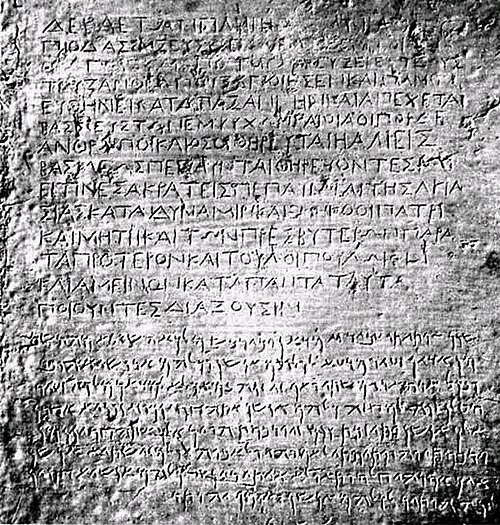
Bilingual inscription (Greek and Aramaic) by Ashoka, third century BCE at Kandahar, Afghanistan

Mandaic magical "demon trap"