Osteichthyes
Videos
Osteichthyes, also known as osteichthyans or commonly referred to as the bony fish, is a diverse superclass of vertebrate animals that have endoskeletons primarily composed of bone tissue. They can be contrasted with the Chondrichthyes and the extinct placoderms and acanthodians, which have endoskeletons primarily composed of cartilage. The vast majority of extant fish are members of Osteichthyes, being an extremely diverse and abundant group consisting of 45 orders, over 435 families and 28,000 species. It is the largest class of vertebrates in existence today, encompassing most aquatic vertebrates, as well as all semi-aquatic and terrestrial vertebrates.


Guiyu oneiros, the earliest known bony fish, lived during the Late Silurian, 425 million years ago. It has a combination of both ray-finned and lobe-finned features.
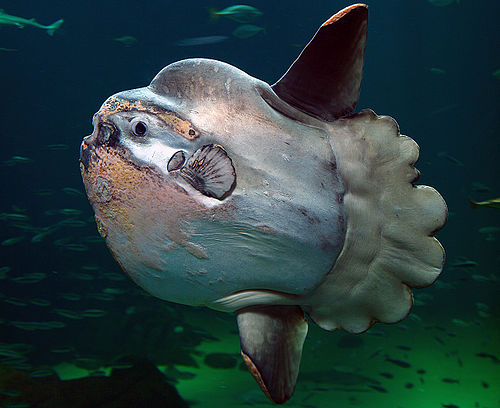
The ocean sunfish is one of the heaviest bony fish in the world.

Image: Carassius carassius
Silurian
Videos
The Silurian is a geologic period and system spanning 24.6 million years from the end of the Ordovician Period, at 443.8 million years ago (Mya), to the beginning of the Devonian Period, 419.2 Mya. The Silurian is the shortest period of the Paleozoic Era. As with other geologic periods, the rock beds that define the period's start and end are well identified, but the exact dates are uncertain by a few million years. The base of the Silurian is set at a series of major Ordovician–Silurian extinction events when up to 60% of marine genera were wiped out.

Ordovician-Silurian boundary on Hovedøya, Norway, showing brownish late Ordovician mudstone and later dark deep-water Silurian shale. The layers have been overturned by the Caledonian orogeny.

Fossils of the late Silurian sea bed

Silurian sea bed fossils collected from Wren's Nest Nature Reserve, Dudley UK

Crinoid fragments in a Silurian (Pridoli) limestone (Saaremaa, Estonia)