Phineas Gage
Videos
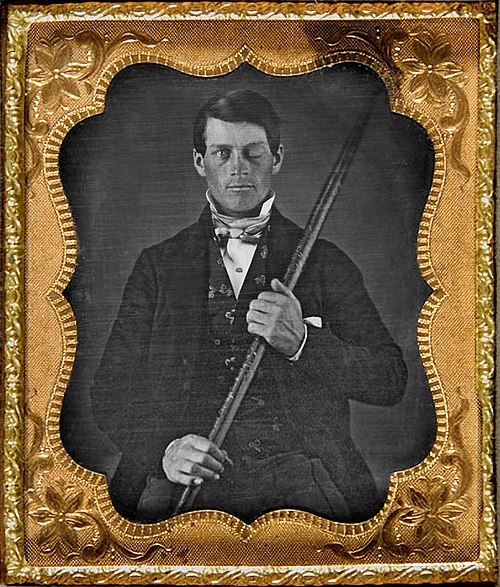
Phineas P. Gage (1823–1860) was an American railroad construction foreman remembered for his improbable[B1] survival of an accident in which a large iron rod was driven completely through his head, destroying much of his brain's left frontal lobe, and for that injury's reported effects on his personality and behavior over the remaining 12 years of his life—effects sufficiently profound that friends saw him as "no longer Gage".

The "cone of uncertainty" for the path taken by the tamping iron. Gage's mouth was open at the moment of the explosion, and the front and back of his skull temporarily "hinged" apart as the iron entered from below, then were pulled back together by the resilience of soft tissues once the iron had exited through the top of Gage's head.

The first known report of Gage's accident, understating the thickness of his tamping iron (by confusing its diameter with its circumference) and overstating the iron's length and the damage to Gage's jaw.[M] "[Gage's] fame is of the kind that is, and in his case literally so, thrust upon otherwise ordinary people", writes Malcolm Macmillan.[M]

The entry damage to Gage's left cheek, and the raised bone fragment in the exit area above his forehead, are visible in this plaster cast taken in late 1849.
Cavendish (CDP), Vermont
Videos
Cavendish is a census-designated place, the central village of the town of Cavendish, Windsor County, Vermont, United States. Until the mid–nineteenth century it was known as Duttonsville. As of the 2010 census, the population of the CDP was 179, compared to 1,367 for the entire town of Cavendish.

Cavendish Volunteer Fire Department