Syncretism
Videos
Syncretism is the practice of combining different beliefs and various schools of thought. Syncretism involves the merging or assimilation of several originally discrete traditions, especially in the theology and mythology of religion, thus asserting an underlying unity and allowing for an inclusive approach to other faiths. While syncretism in art and culture is sometimes likened to eclecticism, in the realm of religion, it specifically denotes a more integrated merging of beliefs into a unified system, distinct from eclecticism, which implies a selective adoption of elements from different traditions without necessarily blending them into a new, cohesive belief system. Syncretism also manifests in politics, known as syncretic politics.

The gods Persephone-Isis and Hades-Serapis, an example of Greco-Egyptian syncretism
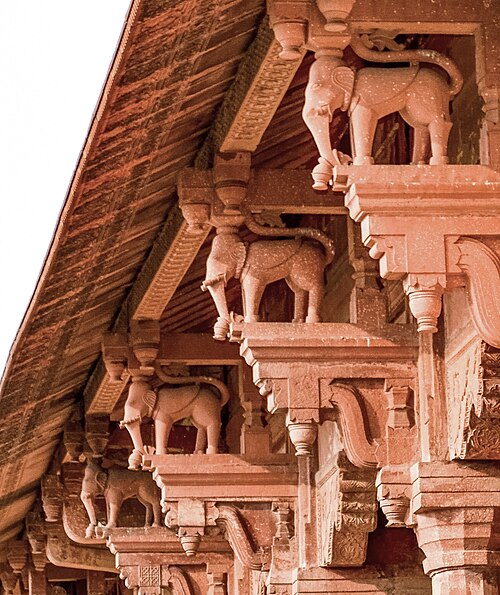
The use of elephant-shaped column brackets in buildings of the Lahore Fort reflects Hindu influences on Mughal Architecture during the reign of Akbar. Islam forbids representation of living figures.

The god Hermanubis, an example of Greco-Egyptian syncretism

The god Taranis-Jupiter, an example of Romano-Celtic syncretism
Osiris
Videos
Osiris is the god of fertility, agriculture, the afterlife, the dead, resurrection, life, and vegetation in ancient Egyptian religion. He was classically depicted as a green-skinned deity with a pharaoh's beard, partially mummy-wrapped at the legs, wearing a distinctive atef crown, and holding a symbolic crook and flail. He was one of the first to be associated with the mummy wrap. When his brother Set cut him up into pieces after killing him, Osiris' wife Isis found all the pieces and wrapped his body up, enabling him to return to life. Osiris was widely worshipped until the decline of ancient Egyptian religion during the rise of Christianity in the Roman Empire.


Scenes from the north wall of the burial chamber of Tutankhamun. On the left side, Tutankhamun, followed by his ka (an aspect of his soul), embraces Osiris.

The gods Osiris, Anubis, and Horus. Wall painting in the tomb of Horemheb (KV57).

The family of Osiris. Osiris on a lapis lazuli pillar in the middle, flanked by Horus on the left and Isis on the right (Twenty-second Dynasty, Louvre, Paris)