The 12th Light Horse Regiment was a mounted unit of the Australian Army. It was raised in New South Wales in 1915 as part of the Australian Imperial Force for service during the First World War. After

Members of the 12th Light Horse training at Holsworthy, 1915.

Men and horses from the 12th Light Horse Regiment rest at Mahadat, Sinai, in September 1916 following the conclusion of fighting around Romani.

Photograph claimed to be of the charge of the 4th Light Horse Brigade at Beersheba, although it may be a re-enactment taken in February 1918.

Horses from the 12th Light Horse Regiment drink at Beersheba.
4th Light Horse Brigade
Videos
The 4th Light Horse Brigade was a mounted infantry brigade of the Australian Imperial Force serving in the Middle Eastern theatre of World War I. The brigade was initially formed as a part-time militi
12th Light Horse Regiment (Australia)
…for service overseas during the First World War. Drawing the majority of its personnel from outback New South Wales, the regiment was assigned to the 4th Light Horse Brigade along with the 11th and 13th Light Horse Regiments and was placed under the command of Lieutenant Colonel Percy Abbott. Upon establishment, the regiment…

Australian Light Horse monument at Beersheba
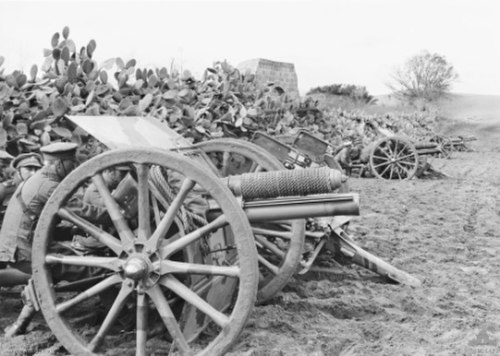
Gunners of A Battery, Honourable Artillery Company, attached to the 4th Australian Light Horse Brigade, crouch between their 13 pounder quick fire field guns and a cactus hedge near Belah, Palestine, in March 1918.