1893 Franco-Siamese crisis
Videos
Photos
The Franco-Siamese crisis of 1893, known in Thailand as the Incident of Rattanakosin Era 112 was a conflict between the French Third Republic and the Kingdom of Siam. Auguste Pavie, French vice consul in Luang Prabang in 1886, was the chief agent in furthering French interests in Laos. His intrigues, which took advantage of Siamese weakness in the region and periodic invasions by Vietnamese rebels from Tonkin, increased tensions between Bangkok and Paris. The conflict concluded with the Paknam Incident, in which French gunboats sailed up the Chao Phraya River to blockade Bangkok. The Siamese subsequently agreed to cede the area that constitutes most of present-day Laos to France, an act that led to the significant expansion of French Indochina.

French ships Inconstant and Comète under fire in the Paknam incident, 13 July 1893. The Graphic.

Punch Magazine cartoon showing the "French wolf" looking across the Mekong toward the "Siamese lamb"

A cartoon from the British newspaper The Sketch shows a French soldier attacking a Siamese soldier depicted as a harmless wooden figure, reflecting the technological superiority of French troops.
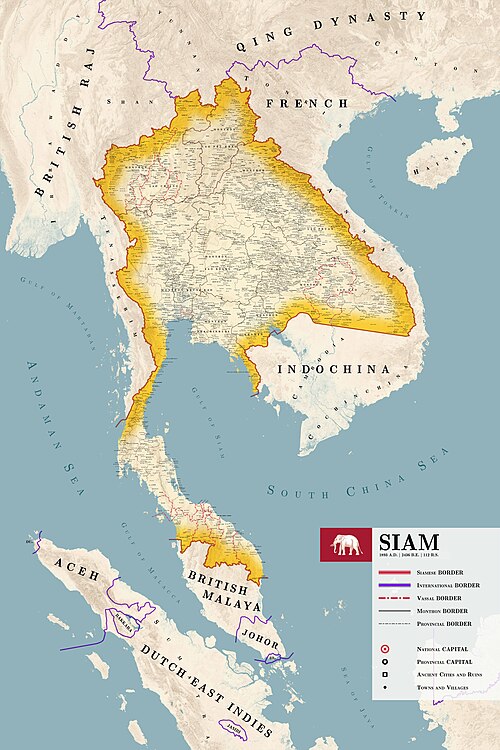
Siam Pre-1893 Partition (1893)
Auguste Pavie
Videos
Photos
Auguste Jean-Marie Pavie was a French colonial civil servant, explorer and diplomat who was instrumental in establishing French control over Laos in the last two decades of the 19th century. After a long career in Cambodia and Cochinchina, Pavie became the first French vice-consul in Luang Prabang in 1886, eventually becoming the first Governor-General and plenipotentiary minister of the newly formed French colony of Laos.

Auguste Pavie in 1893.

View of Kampot from Bokor Hill Station

Luang Prabang on the Mekong River

Auguste Pavie doing surveying work in Cambodia in 1879