1945 Indian general election
General elections were held in British India in December 1945 to elect members of the Central Legislative Assembly and the Council of State. The Indian National Congress emerged as the largest party, winning 57 of the 102 elected seats. The Muslim League won all Muslim constituencies, but failed to win any other seats. Of the 13 remaining seats, 8 went to Europeans, 3 to independents, and 2 to Akali candidates in the Sikh constituencies of Punjab. This election coupled with the provincial one in 1946 proved to be a strategic victory for Jinnah and the partitionists. Even though Congress won, the League had united the Muslim vote and as such it gained the negotiating power to seek a separate Muslim homeland as it became clear that a united India would prove highly unstable. The elected members later formed the Constituent Assembly of India.
Image: Maulana Abul Kalam Azad 1988 stamp of India (cropped)
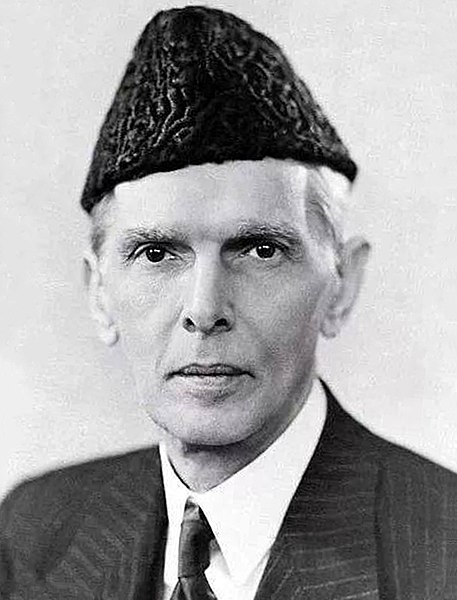
Image: Jinnah 1945c
1946 Indian provincial elections
Provincial elections were held in British India in January 1946 to elect members of the legislative councils of the Indian provinces. The consummation of British rule in India were the 1945/1946 elections. As minor political parties were eliminated, the political scene became restricted to the Indian National Congress and the Muslim League who were more antagonised than ever. The Congress, in a repeat of the 1937 elections, won 90 percent of the general non-Muslim seats while the Muslim League won the majority of Muslim seats (87%) in the provinces. Nevertheless, the All India Muslim League verified its claim to be the sole representative of Muslim India. The election laid the path to Pakistan.
Image: Maulana Abul Kalam Azad 1988 stamp of India (cropped)
Image: Jinnah 1945c
Image: PC Joshi 1937