The 2008 financial crisis was followed by a global resurgence of interest in Keynesian economics among prominent economists and policy makers. This included discussions and implementation of economic
John Maynard Keynes


Prime Minister Clement Attlee (left) with King George VI. Attlee based the British post-World War II economic policy on Keynes' ideas.

Friedrich Hayek, Keynes' leading contemporary critic. Milton Friedman began to take over this role by the late 1950s.

During his term as the 13th prime minister of India, economist Manmohan Singh spoke strongly in favour of Keynesian fiscal stimulus at the 2008 G-20 Washington summit.
The post-war displacement of Keynesianism involved the replacement of Keynesian economics as the leading theoretical influence on economic life in the developed world. Similarly, the allied discipline
John Maynard Keynes (right) and Harry Dexter White at the Bretton Woods Conference in 1944

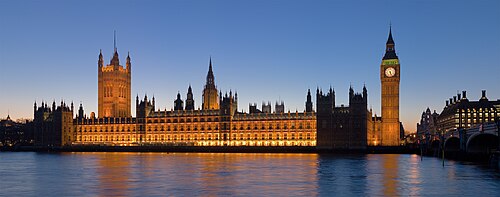
The Houses of Parliament (UK). Governments were generally viewed positively for the first two decades after World War II, but later, especially in English-speaking nations, the public began to take a more cynical view.