2014 in science
Videos
A number of significant scientific events occurred in 2014, including the first robotic landing on a comet and the first complete stem-cell-assisted recovery from paraplegia. The year also saw a signi
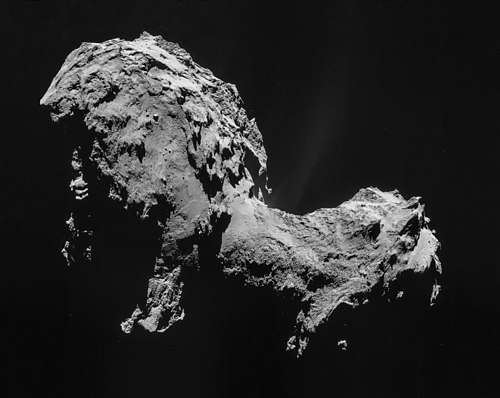
In November 2014, the Philae lander launched by the European Space Agency's Rosetta spacecraft performed the first successful landing on a comet (Philae's target, Comet 67P, pictured).

1 January 2014: New computer models show that climate change is more sensitive to the effects of cloud formation than previously thought.

"Mystery" rock? found by the Opportunity rover on the planet Mars – comparison of images: Sol 3528 and Sol 3540 (23 January 2014) (b/w) (solution).

First image by the Curiosity rover of the Earth and Moon in the night sky of Mars (31 January 2014).
Solar System
Videos
The Solar System is the gravitationally bound system of the Sun and the masses that orbit it, most prominently its eight planets, of which Earth is one. The Solar System is an isolated single-star pla
2014 in science
…wakes up" from hibernation mode to monitor comet 67P/Churyumov–Gerasimenko for the next 16 months as the comet travels into, and then out of, the inner Solar System. The spacecraft is expected to deploy the Philae lander on the comet's surface in November 2014. 21 January Globally, 2013 was tied with 2003 as the…

Diagram of the early Solar System's protoplanetary disk, out of which Earth and other Solar System bodies formed

A color enhanced photograph from the Moon of a range of components of the Solar System. The three dots at the lower left are from left to right the planets Saturn, Mars, and Mercury, and in the middle of the picture rises the Sun's corona over the dark limb of the Moon, which is from the right lit by earthshine.

Comparison of the habitable zones of the Solar System and TRAPPIST-1, an ultracool red dwarf star known to have seven terrestrial planets in stable orbits around the star.

Comparison of the habitable zones for different stellar temperatures, with a sample of known exoplanets plus the Earth, Mars, and Venus. From top to bottom are an F-type main-sequence star, a yellow dwarf (G-type main-sequence star), an orange dwarf (K-type main-sequence star), a typical red dwarf, and an ultra-cool dwarf.