The A-1 lifeboat was a powered lifeboat that was made to be dropped by fixed-wing aircraft into water to aid in air-sea rescue operations. The sturdy airborne lifeboat was to be carried by a heavy bomber specially modified to handle the external load of the lifeboat. The A-1 lifeboat was intended to be dropped by parachute during Dumbo missions to land within reach of the survivors of an accident on the ocean, specifically airmen survivors of an emergency water landing.
A Boeing SB-17G, an air-sea rescue aircraft modified to carry the A-1 lifeboat
Boeing SB-17G "Ready Teddy," Morotai Island, 1945 (Courtesy of the City of Coffs Harbour, Accession Number mus07-8837).
Dumbo was the code name used by the United States Navy during the 1940s and 1950s to signify search and rescue missions, conducted in conjunction with military operations, by long-range aircraft flying over the ocean. The purpose of Dumbo missions was to rescue downed American aviators as well as seamen in distress. Dumbo aircraft were originally land-based heavy bomber aircraft converted to carry an airborne lifeboat to be dropped in the water near survivors. The name "Dumbo" came from Walt Disney's flying elephant, the main character of the animated film Dumbo, appearing in October 1941.
USAF Air Rescue Service Boeing SB-17G, an air-sea rescue variant of the B-17 Flying Fortress
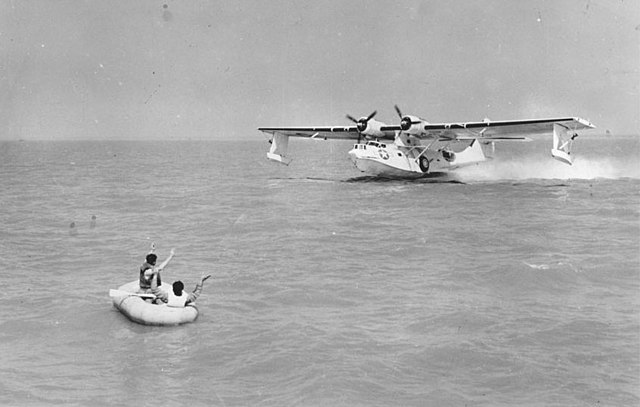
A USAAF Consolidated OA-10A Catalina (Army Air Forces designation of the Navy PBY) amphibious flying boat landing in waters off Keesler Field, Mississippi during a training exercise with U.S. Marine Corps rescue boat crews in 1944
RAF Coastal Command Vickers Warwick ASR (air-sea rescue) aircraft with a droppable airborne lifeboat under the fuselage
A Navy PBM Mariner flying boat rescues Lt. (jg) J. M. Denison, shot down while operating from the escort carrier USS Marcus Island (CVE-77) in 1945