Abdication of Wilhelm II
Videos
The abdication of Wilhelm II as German Emperor and King of Prussia was declared by Chancellor Maximilian of Baden on 9 November 1918; it was formally affirmed by a written statement of Wilhelm on 28 November, made while in exile in Amerongen, the Netherlands. The abdication caused the German Empire to dissolve and concluded the House of Hohenzollern's 500-year rule over Prussia and its predecessor state, Brandenburg. Wilhelm reigned from 15 June 1888 to 9 November 1918. As a result of the abdication and the German Revolution of 1918–19, the nobility as a legally-defined class was abolished. Following the proclamation of the Weimar Constitution on 11 August 1919, all Germans were declared equal before the law. The rulers of the twenty-two constituent states of the Empire also had to relinquish their monarchical titles and domains.

German General Headquarters, 8 January 1917. Chief of the General Staff Field Marshal Paul von Hindenburg and Wilhelm II with General Erich Ludendorff.

Placard for The Pall Mall Gazette, 26 June 1919

Reichskriegsflagge in use during the Kapp Putsch, to overthrow the Weimar Republic and establish a right-wing government, supported by monarchist factions, 13 March 1920

Monarchist DNVP leader Kuno von Westarp and DNVP member Prince Oskar of Prussia with Prince Eitel Friedrich. December 1924. Later, the nationalist DNVP and NSDAP (Nazi Party) were in a coalition government (1933-1945).
Oberste Heeresleitung
Videos
The Oberste Heeresleitung was the highest echelon of command of the army (Heer) of the German Empire. In the latter part of World War I, the Third OHL assumed dictatorial powers and became the de facto political authority in the Empire.


Image: Erich von Falkenhayn retouched
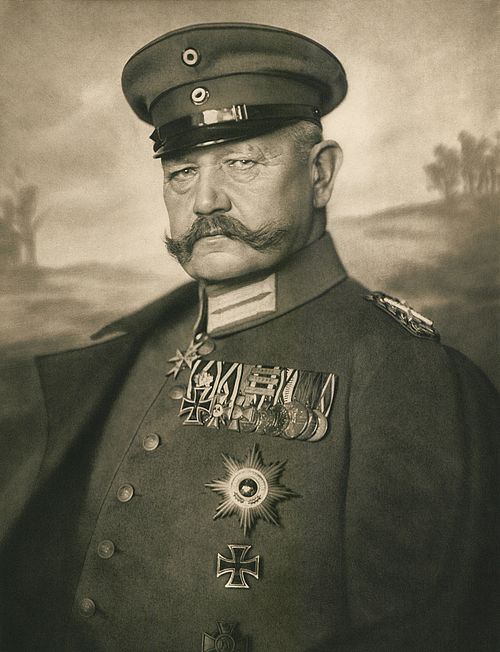
Image: Paul von Hindenburg (1914) von Nicola Perscheid (cropped)