Accretion (astrophysics)
Videos
In astrophysics, accretion is the accumulation of matter into a massive object by gravitationally attracting more matter. If the matter is gaseous the result is an accretion disc. Accretion of solid m
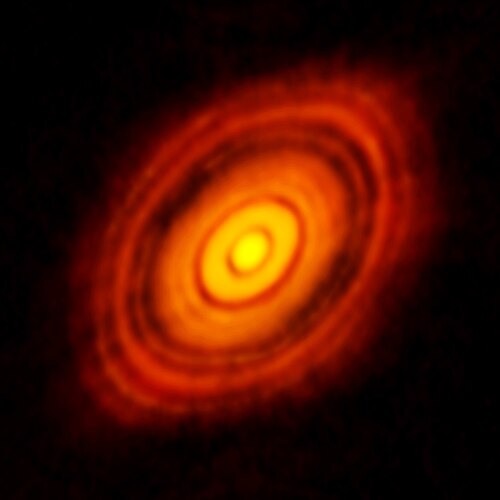
ALMA image of HL Tauri, a protoplanetary disk

The visible-light (left) and infrared (right) views of the Trifid Nebula, a giant star-forming cloud of gas and dust located 5,400 light-years (1,700 pc) away in the constellation Sagittarius

Infrared image of the molecular outflow from an otherwise hidden newborn star HH 46/47

When the lower-mass star in a binary system enters an expansion phase, its outer atmosphere may fall onto the compact star, forming an accretion disk
Protoplanetary disk
Videos
A protoplanetary disk is a rotating circumstellar disc of dense gas and dust surrounding a young newly formed star, a T Tauri star, or Herbig Ae/Be star. The protoplanetary disk may not be considered
Accretion (astrophysics)
…via pebble accretion appears incompatible with the final masses and compositions of Uranus and Neptune. Direct calculations indicate that, in a typical protoplanetary disk, the formation time of a giant planet via pebble accretion is comparable to the formation times resulting from planetesimal accretion. The formation…

A 2009 image showing fractions of stars that suggest some evidence of having a protoplanetary disk as a function of their stellar age in millions of years; The samples are nearby young clusters and associations.

Protoplanetary disk. Simulated spiral arm vs observational data.

An artist's illustration giving a simple overview of the main regions of a protoplanetary disk, delineated by the soot and frost line, which for example has been observed around the star V883 Orionis.