Aeroponics
Videos
Aeroponics is the process of cultivating plants in an air or mist environment, eliminating the need for soil or an aggregate medium. The term "aeroponic" originates from the ancient Greek: aer and pon
Lettuce and wheat grown in an aeroponic apparatus, NASA, 1998


Close-up of the first patented aeroponic plant support structure (1983). Its unrestricted support of the plant allows for normal growth in the air/moisture environment, and is still in use today.

Roots inside a High-pressure Aeroponics System

GTi's Genesis Rooting System, 1983
Foam
Videos
Foam is a two-phase material system and a type of dispersed media, consisting of gas cells dispersed in a continuous liquid or solid phase to form a cellular structure. In most foams, the gas occupies
Aeroponics
…the leaves and crown, referred to as the canopy, extends above. The plant support structure keeps the roots separated. To minimize labor and expenses, closed-cell foam is often compressed around the lower stem and inserted into an opening in the aeroponic chamber. In the case of larger plants, trellising is employed…

Top of a foamy drink

Schematic stress-strain curve of an elastomeric foam, demonstrating the three regions which are linear elastic, cell-wall buckling, and cell-wall fracture, where the area under the curve specified represents the energy per unit volume the foam can absorb.[citation needed]

Cleaning sponge
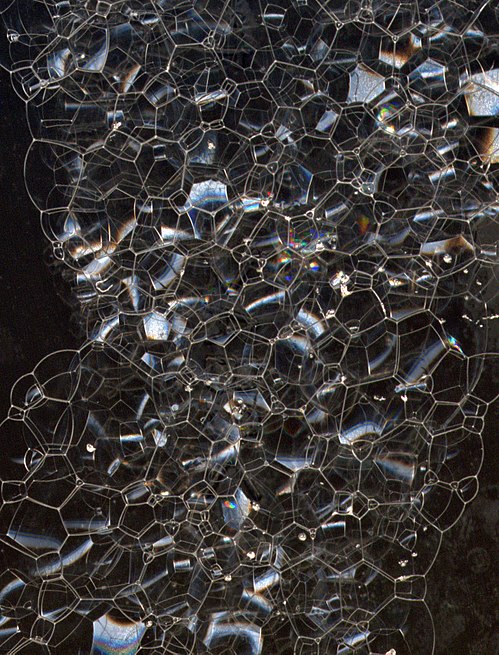
Soap foam bubbles