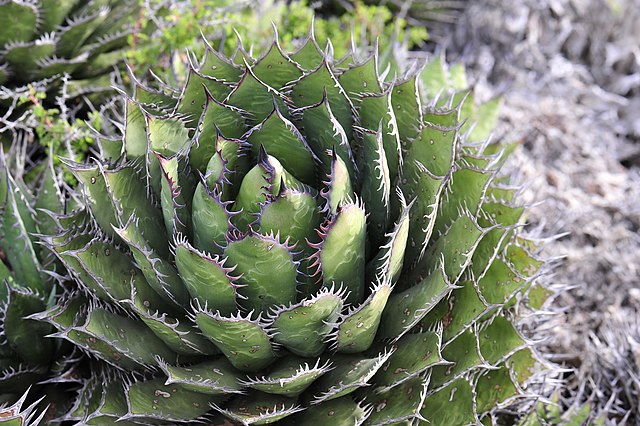
Agave shawii is a species of monocarpic succulent plant in the genus Agave, commonly known as Shaw's agave. It is a rosette-forming plant characterized by glossy, green leaves with toothed margins. After several years of slow growth, the plant puts all of its resources to produce a towering stalk of flowers, and then dies. The death of the flowering rosette is compensated by the growth of numerous clonal pups. This species is segregated into two subspecies, one native to the coast of southwestern California and northwestern Baja California, known commonly as the coast agave, and another native to the Baja California desert, known as the Goldman agave.
Agave shawii
The colorful spines on the margins of the leaves
A rosette, with the water of the San Diego Bay in the background
A planted colony overlooking the San Diego Bay
Agave is a genus of monocots native to the arid & meso regions of the Americas. The genus is primarily known for its succulent and xerophytic species that typically form large rosettes of strong, fleshy leaves. Agave now includes species formerly placed in a number of other genera, such as Manfreda, ×Mangave, Polianthes and Prochnyanthes.
Agave
The large flower spike of Agave chiapensis, San Francisco Botanical Garden
A row of agaves in bloom in the Karoo region of South Africa: The inflorescences of the plants are clearly visible.
Fibers inside a huachuca agave leaf (Agave parryi)