Agesander of Rhodes
Videos
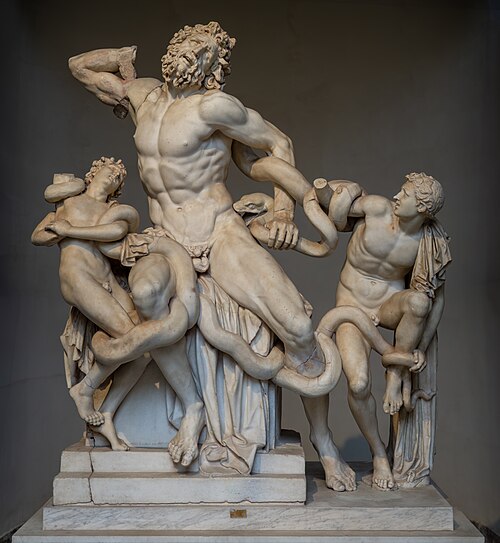
Agesander was one, or more likely, several Greek sculptors from the island of Rhodes, working in the first centuries BC and AD, in a late Hellenistic "baroque" style. If there was more than one sculptor called Agesander they were very likely related to each other. The very important works of the groups of Laocoön and His Sons, in the Vatican Museums, and the sculptures discovered at Sperlonga are both signed by three sculptors including an Agesander.

The "Scylla group" of the Sperlonga sculptures. The signatures are carved on the ship's prow.

The central group of the Sperlonga sculptures, with the Blinding of Polyphemus
Hellenistic art
Videos
Hellenistic art is the art of the Hellenistic period generally taken to begin with the death of Alexander the Great in 323 BC and end with the conquest of the Greek world by the Romans, a process well underway by 146 BC, when the Greek mainland was taken, and essentially ending in 30 BC with the conquest of Ptolemaic Egypt following the Battle of Actium. A number of the best-known works of Greek sculpture belong to this period, including Laocoön and His Sons, Venus de Milo, and the Winged Victory of Samothrace. It follows the period of Classical Greek art, while the succeeding Greco-Roman art was very largely a continuation of Hellenistic trends.

Scene from the Alexander Sarcophagus

Bronze portrait of an unknown sitter, with inlaid eyes, Hellenistic period, 1st century BC, found in Lake Palestra of the Island of Delos.

The Barberini Faun, 2nd-century BC Hellenistic or 2nd-century AD Roman copy of an earlier bronze

The Ludovisi Gaul killing himself and his wife, Roman copy after the Hellenistic original, Palazzo Massimo alle Terme.