Akkadian Empire
Videos
The Akkadian Empire or the Kingdom of Akkad/Agade was an ancient kingdom established around 2334 BCE, and the first empire in world history, succeeding the long-lived city-states of Sumer. Centered on
Bronze head of an Akkadian ruler, discovered in Nineveh in 1931, presumably depicting either Sargon or, more probably, Sargon's grandson Naram-Sin.


Sargon on his victory stele, with a royal hair bun, holding a mace and wearing a flounced royal coat on his left shoulder with a large belt (left), followed by an attendant holding a royal umbrella. The name of Sargon in cuneiform ("King Sargon") appears faintly in front of his face. Louvre Museum.
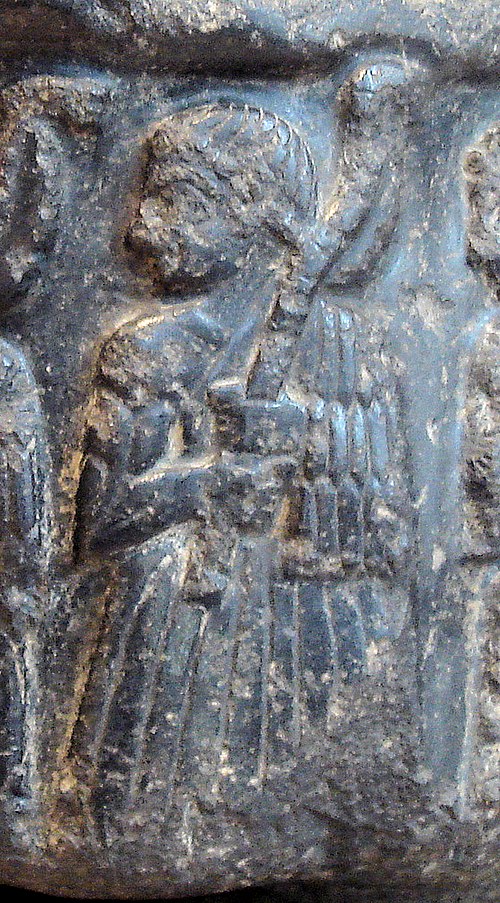
Akkadian official in the retinue of Sargon of Akkad, holding an axe

Prisoners escorted by a soldier, on a victory stele of Sargon of Akkad, circa 2300 BC. The hairstyle of the prisoners (curly hair on top and short hair on the sides) is characteristic of Sumerians, as also seen on the Standard of Ur. Louvre Museum.
Akkad (city)
Videos
Akkad was the capital of the Akkadian Empire, which was the dominant political force in Mesopotamia during a period of about 150 years in the last third of the 3rd millennium BC.
Akkadian Empire
…kingdom established around 2334 BCE, and the first empire in world history, succeeding the long-lived city-states of Sumer. Centered on the city of Akkad ( or ) and its surrounding region in modern-day Iraq, the empire united the Semitic Akkadian and Sumerian speakers under one rule and exercised significant…

Manishtushu Obelisk, with close-up of the text. 2270–2255 BC, Louvre Museum

Agade-ki ("Country of Akkad"), on a cylinder seal of Shar-Kali-Sharri.