Abū Tamīm Maʿad al-Mustanṣir biʾllāh was the eighth Fatimid Caliph from 1036 until 1094. He was one of the longest reigning Muslim rulers. His reign was the twilight of the Fatimid state. The start of his reign saw the continuation of competent administrators running the Fatimid state, overseeing the state's prosperity in the first two decades of al-Mustansir's reign. However, the break out of court infighting between the Turkish and Berber/Sudanese court factions following al-Yazuri's assassination, coinciding with natural disasters in Egypt and the gradual loss of administrative control over Fatimid possessions outside of Egypt, almost resulted in the total collapse of the Fatimid state in the 1060s, before the appointment of the Armenian general Badr al-Jamali, who assumed power as vizier in 1073, and became the de facto dictator of the country under the nominal rule of al-Mustansir.
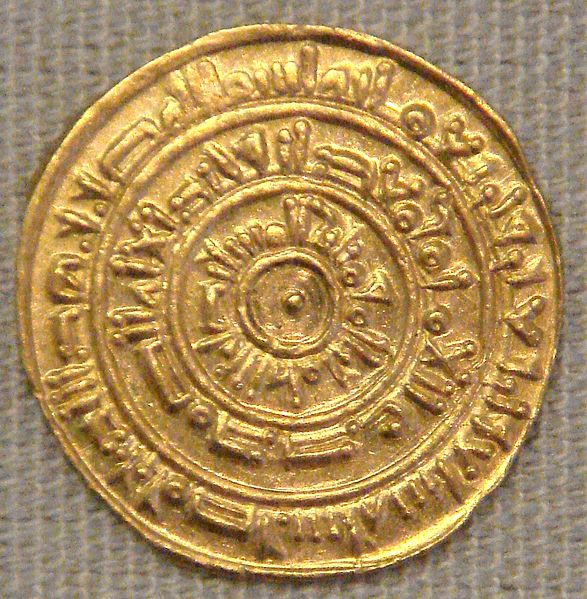
Gold coin of al-Mustansir, Egypt, 1055 CE.
The mihrab made in honour of al-Mustansir Billah in the Mosque of Ibn Tulun with the phrase ʿalī-un-walī-u-allāh at the end, Cairo.
al-Mustansir's mihrab at the Ibn Tulun mosque, Cairo
Stone inscription from al-Mustansir's time near al-Mustansir's mihrab
Sharaf al-Maʿālī Abu Manṣūr Anūshtakīn al-Dizbarī was a Fatimid statesman and general who became the most powerful Fatimid governor of Syria. Under his Damascus-based administration, all of Syria was united under a single Fatimid authority. Near-contemporary historians, including Ibn al-Qalanisi of Damascus and Ibn al-Adim of Aleppo, noted Anushtakin's wealth, just rule and fair treatment of the population, with whom he was popular.
Anushtakin took refuge in the Citadel of Aleppo (pictured) after escaping Damascus. He died in the citadel and left there a treasure of 600,000 gold dinars