Al. T. Stamatiad
Videos
Photos
Al. T. Stamatiad was a Romanian Symbolist poet, short story writer, and dramatist. A late arrival on the local Symbolist scene, he was primarily active as a literary promoter and, in 1918, editor of Literatorul review. Discovered and praised by Alexandru Macedonski and Ion Minulescu, he combined his presence in radical Symbolist circles with stints on more culturally conservative ones, crossing between the extremes of Romanian literature. By 1911, he had established himself in cultural and social circles as an exotic and vocal, sometimes violent, cultural debater.

Stamatiad in an etching by Constantin Artachino, first published in 1920
Symbolist movement in Romania
Videos
Photos
The Symbolist movement in Romania, active during the late 19th and early 20th centuries, marked the development of Romanian culture in both literature and visual arts. Bringing the assimilation of France's Symbolism, Decadence and Parnassianism, it promoted a distinctly urban culture, characterized by cosmopolitanism, Francophilia and endorsement of Westernization, and was generally opposed to either rural themes or patriotic displays in art. Like its Western European counterparts, the movement stood for idealism, sentimentalism or exoticism, alongside a noted interest in spirituality and esotericism, covering on its own the ground between local Romanticism and the emerging modernism of the fin de siècle. Despite such unifying traits, Romanian Symbolism was an eclectic, factionalized and often self-contradictory current.
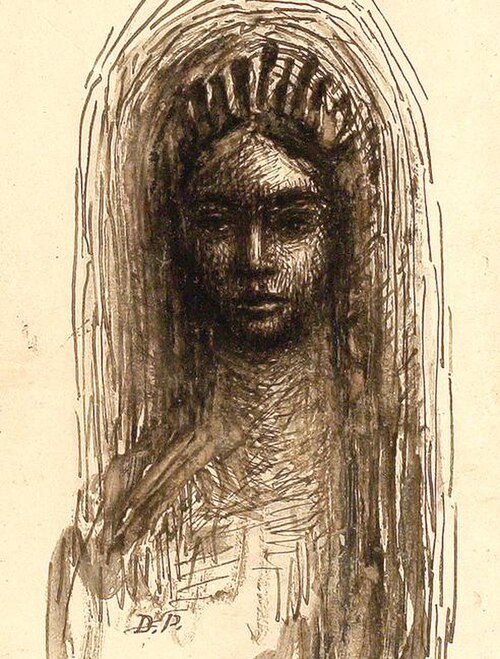
Chimera, ink drawing by Dimitrie Paciurea

"The Symbolist poet", as portrayed by cartoonist Constantin Jiquidi. At the bottom, a stack of papers with the title Literatorul

Some of the Tinerimea Artistică founders, in a caricature by Nicolae Petrescu-Găină (1903)

Ștefan Luchian, Primăvara ("Spring")