The Alamosa–Durango line or San Juan extension was a railroad line built by the Denver and Rio Grande Western Railroad, following the border between the U.S. states of Colorado and New Mexico, in the Rocky Mountains. The line was originally built as a 3 ft narrow-gauge line between Alamosa, Colorado, and Durango, Colorado. Portions of the route survive: the now standard-gauged segment from Alamosa to Antonito, Colorado, and a narrow-gauge portion from Antonito to Chama, New Mexico.
A Denver and Rio Grande Western freight train at Cumbres Pass, CO, 1968.
Denver and Rio Grande Western Railroad
The Denver and Rio Grande Western Railroad, often shortened to Rio Grande, D&RG or D&RGW, formerly the Denver & Rio Grande Railroad, was an American Class I railroad company. The railroad started as a 3 ft narrow-gauge line running south from Denver, Colorado, in 1870. It served mainly as a transcontinental bridge line between Denver and Salt Lake City, Utah. The Rio Grande was also a major origin of coal and mineral traffic.
During the late 1800s the D&RG made extensive use of consolidations (engines with a 2-8-0 wheel arrangement). This drawing, of an unusual wheel arrangement, was titled "Standard Consolidation Engine," 1881.
Over the course of decades, D&RG consolidations were subjected to various modifications. In the 20th century, diamond stacks gave way to straight stacks, box headlights were replaced with round ones, decorative trim disappeared from the domes, and wooden pilots (cowcatchers) were replaced with steel ones.
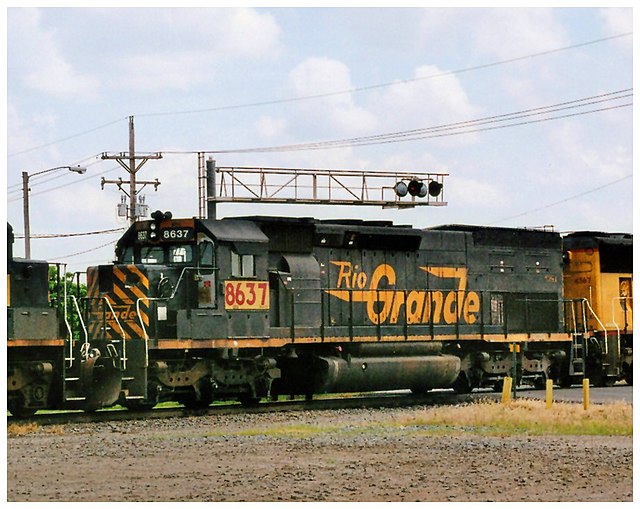
D&RGW 5384, patch-renumbered into UP 8637
D&RGW passenger train at the Colorado Railroad Museum. The F9 A&B diesel electric locomotives (1955) were used for the California Zephyrs and Rio Grande Zephyrs.