Almanzor
Videos
Abu ʿAmer Muḥammad ibn ʿAbdullāh ibn Abi ʿAmer al-Maʿafiri, nicknamed al-Manṣūr, which is often Latinized as Almanzor in Spanish, Almansor in Catalan and Almançor in Portuguese, was a Muslim Arab Anda
Scrivener, in a nineteenth-century representation. After completing his studies as a faqīh, the young Almanzor had to adopt this profession due to the poor economic situation of his family after the death of his father.


Harem scene. Shortly after joining the caliphal Administration, Ibn Abi ʿĀmir forged a lasting alliance with the mother of the heir to the throne, the favorite Subh, which was only broken in 996 by Ibn Abi ʿĀmir's ambitions, which Subh considered a threat to her son Hisham.
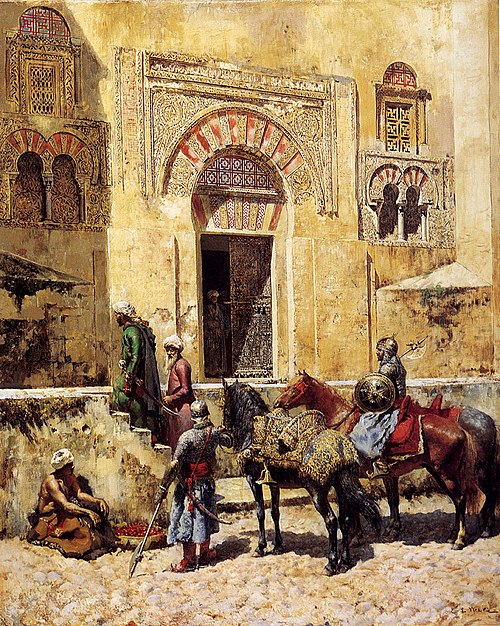
Soldiers outside the mosque according to a nineteenth-century representation. Almanzor soon gained control of the army of the capital, which settled in his new fortified residence in Medina Alzahira [es], built in 979.

Interior of Medina Azahara, the fortified residence built by Abd al-Rahman III, where Almanzor luxuriously locked Caliph Hisham II after the failed attempt at rebellion by the Caliph's mother Subh, after long years of alliance between them.
Al-Andalus
Videos
Al-Andalus refers to the various Muslim ruled territories on the Iberian Peninsula that existed between 711 and 1492. At its height, it covered the entirety of Spain and Portugal, as well as parts of
Almanzor
…Victorious"), which is often Latinized as Almanzor in Spanish, Almansor in Catalan and Almançor in Portuguese (c. 938 – 8 August 1002), was a Muslim Arab Andalusi military leader and statesman. As the chancellor of the Umayyad Caliphate of Córdoba and hajib (chamberlain) for Caliph Hisham II, Almanzor was effectively…

19th-century portrait of Abd al-Rahman I, from Estoria de España

Interior of the Mosque–Cathedral of Córdoba, the former Great Mosque built by Abd ar-Rahman I in 785, later expanded by his successors

Abd al-Rahman III receiving John of Gorze, ambassador of Otto I, at the Medina Azahara, by Dionisio Baixeras Verdaguer, 1885

A silk textile fragment from the last Muslim dynasty of Al-Andalus, the Nasrid Dynasty (1232–1492), with the epigraphic inscription "glory to our lord the Sultan".