Amateur radio direction finding is an amateur racing sport that combines radio direction finding with the map and compass skills of orienteering. It is a timed race in which individual competitors use

A German competitor on a 2-meter band ARDF course

A member of the Republic of Korea national team sprints to the finish line of an eighty meter ARDF course.

A transmitter, orienteering control flag, paper punch and electronic punch device at an ARDF control

Commgames 2006 Mens Marathon
Yagi–Uda antenna
Videos
A Yagi–Uda antenna, or Yagi antenna, is a directional antenna consisting of two or more parallel resonant antenna elements in an end-fire array; these elements are most often metal rods acting as half
Amateur radio direction finding
…all three components into one handheld device. On the two meter band, the most common directional antennas used by competitors are two or three element Yagi antennas made from flexible steel tape. This kind of antenna has a cardioid receiving pattern, which means that it has one peak direction where the received…
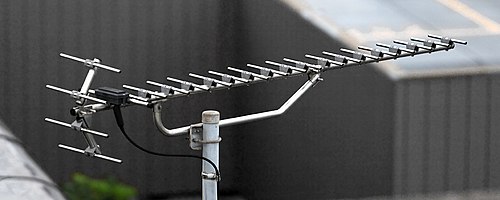
A modern high-gain UHF Yagi television antenna with 17 directors, and one reflector (made of four rods) shaped as a corner reflector

Quartet of two-dipole Yagi arrays (Hirschgeweih) of the German FuG 220 VHF-band radar on the nose of a late-World War II Bf 110 night fighter aircraft

A portable Yagi–Uda antenna for use at 144 MHz (2 m), with segments of yellow tape-measure ribbon for the arms of the driven and parasitic elements.

Two Yagi–Uda antennas on a single mast. The top one includes a corner reflector and three stacked Yagis fed in phase in order to increase gain in the horizontal direction (by cancelling power radiated toward the ground or sky). The lower antenna is oriented for vertical polarization, with a much lower resonant frequency.