Ammonoidea
Videos
Ammonoids are extinct, typically coiled-shelled cephalopods composing the subclass Ammonoidea. They are more closely related to living octopuses, squid, and cuttlefish than they are to nautiluses, whi
Pleuroceras solare, Little Switzerland, Bavaria, Germany


A variety of ammonite forms, from Ernst Haeckel's 1904 Kunstformen der Natur (Art Forms of Nature)

Fossil of Parapuzosia seppenradensis, one of the largest known ammonites

Oppelia in association with its aptychi plates
The Cretaceous–Paleogene extinction event, formerly known as the Cretaceous–Tertiary extinction event, was a major mass extinction of three-quarters of the plant and animal species on Earth which occu
Ammonoidea
…appeared during the Emsian stage of the Early Devonian, around 410-408 million years ago, with the last species vanishing during or soon after the Cretaceous–Paleogene extinction event approximately 66 million years ago. They are often called ammonites, which is most frequently used for members of the order Ammonitida, the only remaining…

Discoscaphites iris, an ammonite from the Owl Creek Formation (Upper Cretaceous), in Owl Creek near Ripley, Mississippi

Rudist bivalves from the Late Cretaceous of the Omani Mountains, United Arab Emirates. Scale bar is 10 mm.
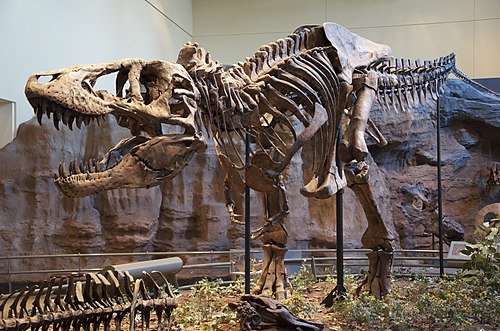
Tyrannosaurus was among the dinosaurs living on Earth before the extinction

Hell Creek Formation