Amr ibn al-As
Videos
Amr ibn al-As ibn Wa'il al-Sahmi was an Arab commander and companion of Muhammad who led the Muslim conquest of Egypt and served as its governor in 640–646 and 658–664. The son of a wealthy Qurayshite

The Amr ibn al-As Mosque in Fustat (Old Cairo), Egypt

The ravines of the Yarmouk River where Amr kept the Byzantines confined at the decisive Battle of Yarmouk in 636

Amr initially halted his campaign at the Babylon Fortress (pictured in 2008), but ultimately forced its Byzantine garrison to evacuate in April 641 after a lengthy siege.
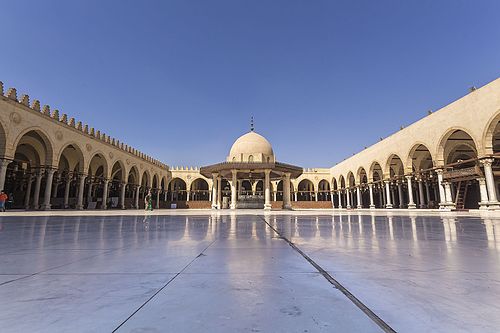
The courtyard of the Amr ibn al-As Mosque in 2013. The mosque was originally founded by Amr in 641 but was redesigned and expanded significantly over the next several centuries.
Arab conquest of Egypt
Videos
Forces of the Rashidun Caliphate led by Amr ibn al-As conquered Byzantine Egypt between 639 and 642 AD. The conquest ended the Roman period in Egypt, which had begun in 30 BC and lasted for approximat
Amr ibn al-As
…Amr ibn al-As ibn Wa'il al-Sahmi (c. 585 – 664) was an Arab commander and companion of Muhammad who led the Muslim conquest of Egypt and served as its governor in 640–646 and 658–664. The son of a wealthy Qurayshite, Amr embraced Islam in c. 629 and was assigned important roles in…

Remains of the Babylon Fortress in Old Cairo

Ancient Roman theater in Alexandria (present-day archeological site of Kom El Deka)

The Attarine Mosque in Alexandria was originally a church but was converted to a mosque after the surrender of Alexandria.