Andrew Jackson
Videos
Andrew Jackson was the seventh president of the United States from 1829 to 1837. He rose to fame as a U.S. Army general and served in both houses of the U.S. Congress. His political philosophy, which
Formal portrait, c. 1835


The Brave Boy of the Waxhaws, an 1876 Currier and Ives lithograph depicting the story of a young Andrew Jackson defending himself from a British officer during the American Revolutionary War

An 1846 wood engraving by William Croome depicting Jackson's marriage to Rachel Donelson in the 1847 Pictorial History of Andrew Jackson by John Frost

Tennessee c. 1810. The eastern counties shaded in blue, the Mero District in green, and Native American lands in red. The Natchez Trace from its northern terminus to Chickasaw Crossing where it leaves the state is shaded in gray.
Rachel Jackson
Videos
Rachel Jackson was the wife of Andrew Jackson, the seventh president of the United States. She lived with him at their home at the Hermitage, where she died just days after his election and before his
Andrew Jackson
…particularly towards Native Americans. Born in the colonial Carolinas before the American Revolutionary War, Jackson became a frontier lawyer, married Rachel Donelson, and briefly represented Tennessee in both the U.S. House of Representatives and U.S. Senate. After resigning, he served as a Tennessee Superior Court…

Portrait by Ralph E. W. Earl, 1823
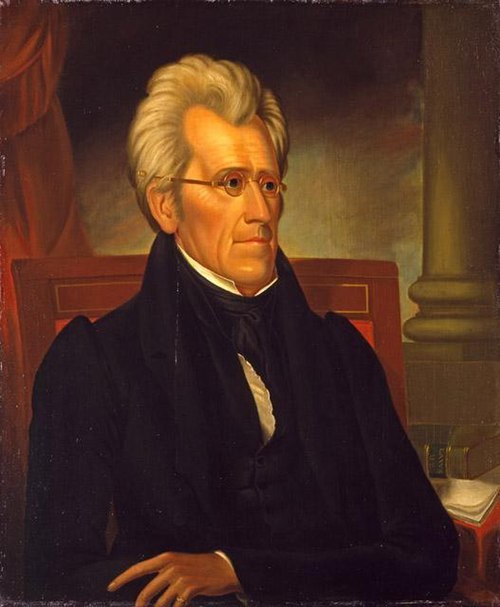
C. 1830–1832 portrait of President Andrew Jackson by Ralph E. W. Earl

The tomb of Andrew and Rachel Jackson at the Hermitage