Anti-satellite weapon
Videos
Anti-satellite weapons (ASAT) are space weapons designed to incapacitate or destroy satellites for strategic or tactical purposes. Although no ASAT system has yet been utilized in warfare, a few countries have successfully shot down their own satellites to demonstrate their ASAT capabilities in a show of force. ASATs have also been used to remove decommissioned satellites.

An artist's impression of a futuristic anti-satellite weapon capable of destroying satellites using its "circular saw" extensions

A US ASM-135 ASAT missile
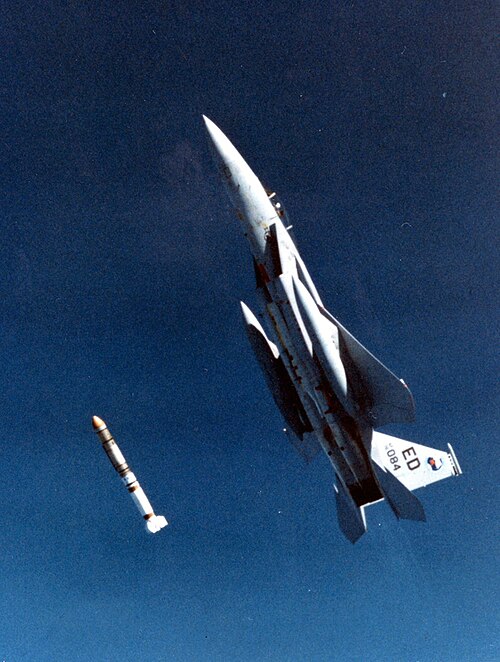
A US Vought ASM-135 ASAT missile launch on 13 September 1985, which destroyed P78-1

A RIM-161 Standard Missile 3 launched from USS Lake Erie, a US Navy Ticonderoga class cruiser, 2005
Kessler syndrome
Videos
The Kessler syndrome, proposed by NASA scientist Donald J. Kessler in 1978, is a scenario in which the density of objects in low Earth orbit (LEO) due to space pollution is numerous enough that collisions between objects could cause a cascade in which each collision generates space debris that increases the likelihood of further collisions. In 2009, Kessler wrote that modeling results had concluded that the debris environment was already unstable, "such that any attempt to achieve a growth-free small debris environment by eliminating sources of past debris will likely fail because fragments from future collisions will be generated faster than atmospheric drag will remove them". One implication is that the distribution of debris in orbit could render space activities and the use of satellites in specific orbital ranges difficult for many generations.

Space debris populations seen from outside geosynchronous orbit (GSO). There are two primary debris fields: the ring of objects in GSO and the cloud of objects in low Earth orbit (LEO).

Baker–Nunn cameras were widely used to study space debris.