Antyesti
Videos
Antyesti, also known as Antima Samskara, Antya-kriya, Anvarohanyya, or as Vahni Samskara, literally means "last sacrifice" or "final auspicious ceremony", and refers to the funeral rites for the dead

An 1820 painting showing a Hindu funeral procession in south India. The pyre is to the left, near a river, the lead mourner is walking in front, the dead body is wrapped in white and is being carried to the cremation pyre, relatives and friends follow

A Hindu cremation rite in Nepal. The samskara above shows the body wrapped in saffron cloth on a pyre.

Cremation of Mahatma Gandhi at Rajghat, 31 January 1948. It was attended by Sardar Vallabh Bhai Patel, Jawaharlal Nehru, Lord and Lady Mountbatten, Maulana Azad, Rajkumari Amrit Kaur, Sarojini Naidu and other national leaders. His son Devdas Gandhi lit the pyre.
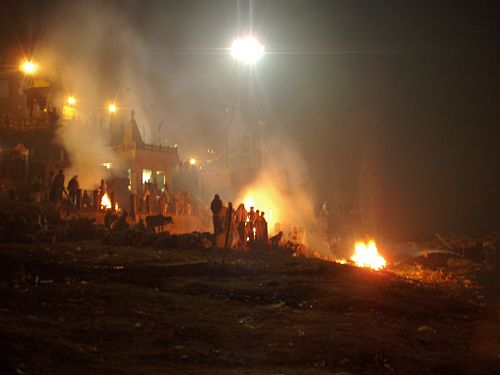
Burning ghats of Manikarnika, at Varanasi, India.
Samskara (rite of passage)
Videos
Samskara are diverse rites of passage in Hinduism, Jainism, Buddhism and Sikhism. The word literally means "putting together, making perfect, getting ready, to prepare", or "a sacred or sanctifying ce
Antyesti
…for the dead in Hinduism, which usually involves cremation of the body. This rite of passage is the last samskara in a series of traditional life cycle samskaras that start from conception in Hindu tradition. The details of the Antyesti ceremony depend on the region, social group, gender and age of the dead…

Samskaras are, in one context, the diverse rites of passage of a human being from conception to cremation, signifying milestones in an individual's journey of life in Hinduism. Above is annaprashana samskara celebrating a baby's first taste of solid food.

A new born's Namakarana ceremony. The grandmother is whispering the name into the baby's ear, while friends and family watch.

Annaprashanam is the rite of passage where the baby is fed solid food for the first time. The ritual has regional names, such as Choroonu in Kerala.

A baby's first haircut is called choulam samskara.