Apollo Lunar Module
Videos
The Apollo Lunar Module, originally designated the Lunar Excursion Module, was the lunar lander spacecraft that was flown between lunar orbit and the Moon's surface during the United States' Apollo pr

Apollo 14 Lunar Module Antares on the Moon's surface, February 1971

Lunar Module Eagle, the Lunar Module ascent stage of Apollo 11, in orbit above the Moon. Earth is visible in the distance. Photograph by Michael Collins aboard the Command module Columbia.

A 1962 model of the first LEM design, docked to the command and service module. The model is held by Joseph Shea, the key engineer behind the adoption of lunar orbit rendezvous mission logistics.

This 1963 model depicts the second LEM design, which gave rise to informal references as "the bug".
Apollo 11
Videos
Apollo 11 was the American spaceflight that first landed humans on the Moon, and the fifth crewed mission of NASA's Apollo program. The mission was crewed by Commander Neil Armstrong, Command Module P
Apollo Lunar Module
…without a crew; and Apollo 9 with a crew. A third test flight in low lunar orbit was Apollo 10, a dress rehearsal for the first landing, conducted on Apollo 11. The Apollo 13 Lunar Module functioned as a lifeboat to provide life support and propulsion to keep the crew alive for the trip home, when their CSM…

Buzz Aldrin on the Moon in a photograph taken by Neil Armstrong, who can be seen in the visor reflection along with Earth, the Lunar Module Eagle, and the U.S. flag

Left to right: Armstrong, Collins, and AldrinApollo program← Apollo 10Apollo 12 →
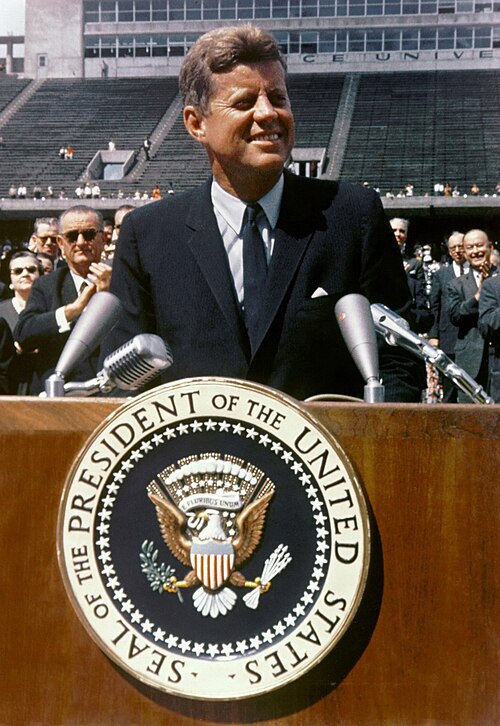
President John F. Kennedy speaking at Rice University on September 12, 1962

CAPCOM Charles Duke (left), with backup crewmembers Lovell and Haise listening in during Apollo 11's descent