Aramaic
Videos
Aramaic is a Northwest Semitic language that originated in the ancient region of Syria and quickly spread to Mesopotamia, the southern Levant, Sinai, southeastern Anatolia, the Caucasus, and Eastern A
The Carpentras Stele was the first ancient inscription ever identified as "Aramaic". Although it was first published in 1704, it was not identified as Aramaic until 1821, when Ulrich Friedrich Kopp complained that previous scholars had left everything "to the Phoenicians and nothing to the Arameans, as if they could not have written at all".


This clay tablet represents a classroom experiment; a teacher imposed a challenging writing exercise on pupils who spoke both Babylonian-Akkadian and Aramaic. The pupils had to use traditional syllabic signs to express the sounds of the Aramaic alphabet. c. 500 BC. From Iraq

One of the Bar-Rakib inscriptions from Sam'al. The inscription is in the Samalian language (also considered a dialect).
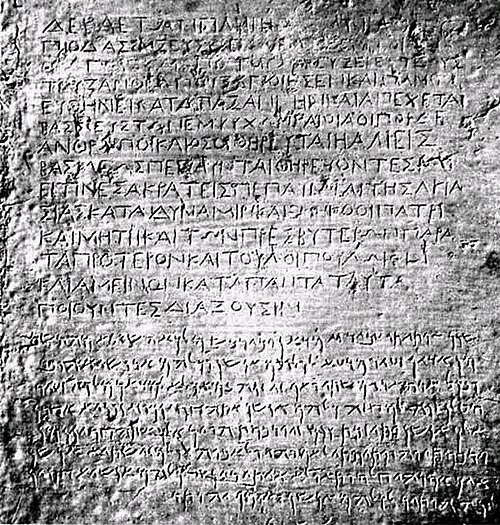
The Kandahar Bilingual Rock Inscription (Greek and Aramaic) by the Indian king Ashoka, 3rd century BC at Kandahar, Afghanistan
Semitic languages
Videos
The Semitic languages are a branch of the Afroasiatic language family. They include Arabic, Amharic, Tigrinya, Aramaic, Hebrew, Maltese, Modern South Arabian languages and numerous other ancient and m
Aramaic
…record and analyze all of the remaining varieties of Neo-Aramaic languages in case they become extinct. Aramaic belongs to the Northwest group of the Semitic language family, which includes the mutually intelligible Canaanite languages such as Hebrew, Edomite, Moabite, Ekronite, Sutean, and Phoenician, as well as Amorite…

Epic of Gilgamesh, an epic poem from ancient Mesopotamia, regarded as the earliest surviving notable literature, written in Akkadian.

Page from a 12th-century Quran in Arabic