Argus laser
Videos
Argus was a two-beam high power infrared neodymium doped silica glass laser with a 20 cm output aperture built at Lawrence Livermore National Laboratory in 1976 for the study of inertial confinement f

Argus laser overhead view. The target chamber area is at the far wall (upper left).
Inertial confinement fusion
Videos
Inertial confinement fusion is a fusion energy process that initiates nuclear fusion reactions by compressing and heating targets filled with fuel. The targets are small pellets, typically containing

Indirect drive laser ICF uses a hohlraum which is irradiated with laser beam cones from either side on its inner surface to bathe a fusion microcapsule inside with smooth high intensity X-rays. The highest energy X-rays can be seen leaking through the hohlraum, represented here in orange/red.
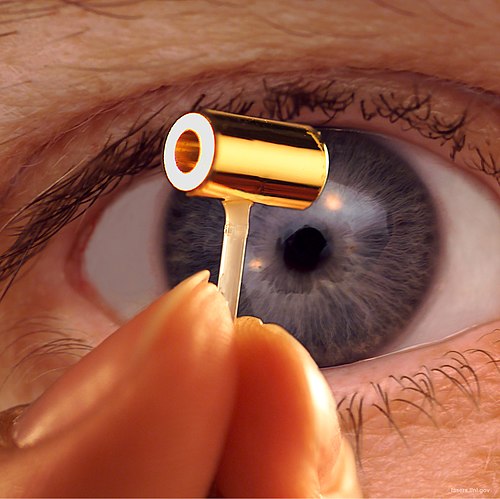
Mockup of a gold plated National Ignition Facility (NIF) hohlraum

An Inertial confinement fusion target, which was a foam filled cylindrical target with machined perturbations, being compressed by the Nova Laser. This shot was done in 1995. The image shows the compression of the target, as well as the growth of the Rayleigh-Taylor instabilities.

An inertial confinement fusion fuel microcapsule (sometimes called a "microballoon") of the size used on the NIF which can be filled with either deuterium and tritium gas or DT ice. The capsule can be either inserted in a hohlraum (as above) and imploded in the indirect drive mode or irradiated directly with laser energy in the direct drive configuration. Microcapsules used on previous laser systems were significantly smaller owing to the less powerful irradiation earlier lasers were capable of delivering to the target.