Aristotle
Videos
Aristotle was an ancient Greek philosopher and polymath. His writings span the natural sciences, philosophy, linguistics, economics, politics, psychology, and the arts. As the founder of the Peripatet
Roman copy of a Greek bust of Aristotle


School of Aristotle in Mieza, Macedonia, Greece

"Aristotle tutoring Alexander" (1895) by Jean Leon Gerome Ferris
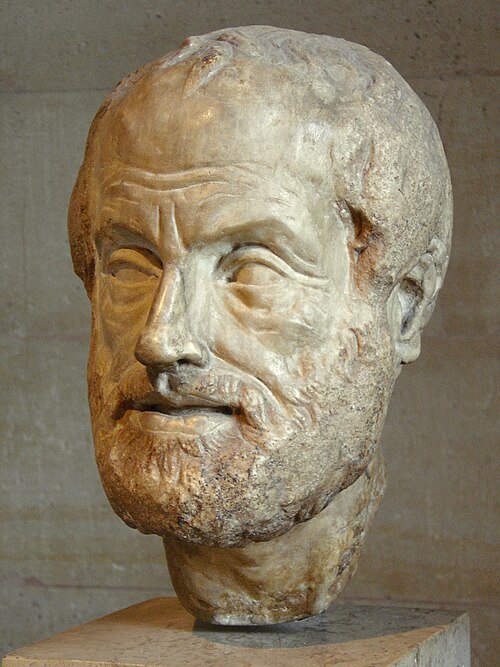
Portrait bust of Aristotle; an Imperial Roman (1st or 2nd century AD) copy of a lost bronze sculpture made by Lysippos
Plato
Videos
Plato was an ancient Greek philosopher of Classical Athens who is most commonly considered the foundational thinker of the Western philosophical tradition. An innovator of the literary dialogue and di
Aristotle
…Classical period. His father, Nicomachus, died when Aristotle was a child, and he was brought up by a guardian. At around eighteen years old, he joined Plato's Academy in Athens and remained there until the age of thirty seven (c. 347 BC). Shortly after Plato died, Aristotle left Athens and, at the request…

Plato was one of the devoted young followers of Socrates, whose bust is pictured above.

Heraclitus (1628) by Hendrick ter Brugghen. Heraclitus saw a world in flux, with everything always in conflict, constantly changing.

Bust of Parmenides from Velia. Parmenides saw the world as eternal and unchanging, that all change was an illusion.
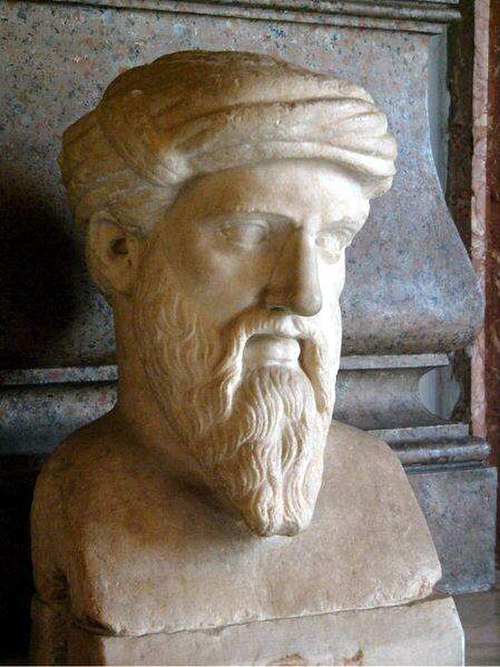
The mathematical and mystical teachings of the followers of Pythagoras, pictured above, exerted a strong influence on Plato.