The Armenians in Greece are Greek citizens of Armenian descent. The Armenian presence in Greece began centuries ago when Armenians, for various reasons, settled in the wider area of Thessaly, Macedonia (Thessaloniki) and Thrace. Traces of Armenians can also be found on the Greek islands of Crete and Kerkyra (Corfu). The Armenians in Greece however, acquired the character of a community after the 1920s, when 70,000 to 80,000 survivors of the Armenian genocide fled to Greece from Cilicia, Smyrna, Ionia, Constantinople and other regions of Asia Minor, scattering all over Greece.
Armenian church at the center of Thessaloniki
View from the Armenian cemetery of Thessaloniki
Armenian is an Indo-European language and the sole member of an independent branch of that language family. It is the native language of the Armenian people and the official language of Armenia. Historically spoken in the Armenian highlands, today Armenian is widely spoken throughout the Armenian diaspora. Armenian is written in its own writing system, the Armenian alphabet, introduced in 405 AD by the canonized saint Mesrop Mashtots. The estimated number of Armenian speakers worldwide is between five and seven million.
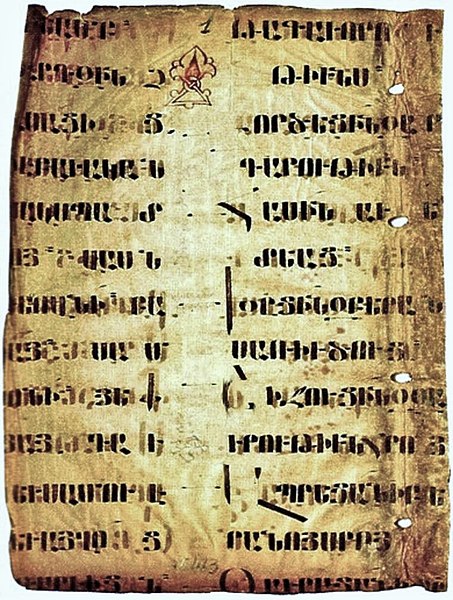
Armenian manuscript, 5th–6th centuries.
The Four Gospels, 1495, Portrait of St Mark Wellcome with Armenian inscriptions
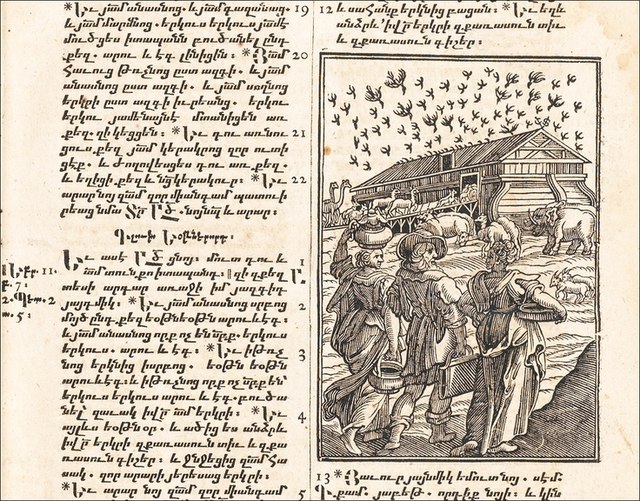
First printed Armenian language Bible, 1666
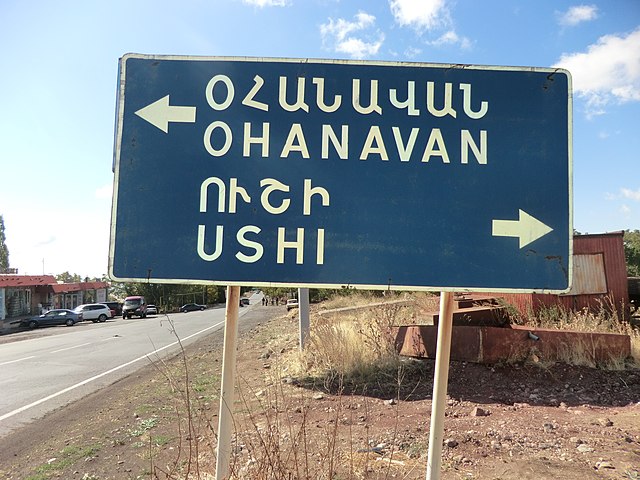
Armenian language road sign.