Art theft and looting occurred on a massive scale during World War II. It originated with the policies of the Axis powers, primarily Nazi Germany and the Empire of Japan, which systematically looted o
Raphael, Portrait of a Young Man, circa 1513 to 1514. Plundered by the Nazis in Poland. Falsely reported to have been found on 1 August 2012, the location is still unknown.


Vincent van Gogh, 1888, The Painter on the Road to Tarascon. Listed as "missing" on Monuments Men Foundation 'Most Wanted' website. Property of Kulturhistorisches Museum in Magdeburg, Germany (formerly the Kaiser-Friedrich Museum).

Gustav Klimt, 1907, Portrait of Adele Bloch-Bauer I. Recovered and sold for US$135 million to Ronald Lauder for his Neue Galerie New York in June 2006, which made it at that time the most expensive painting for about 4 months.
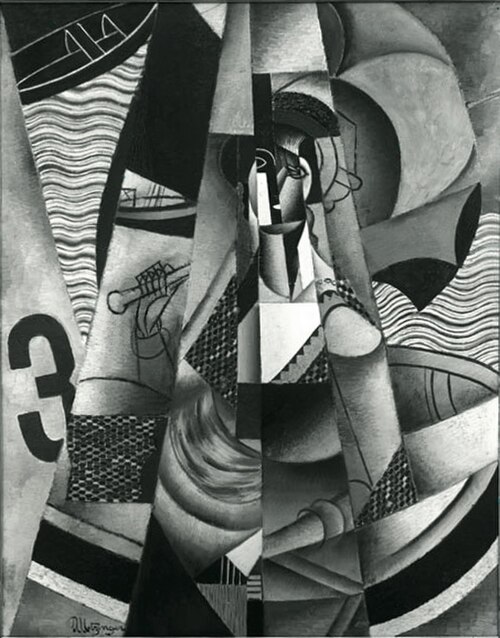
Jean Metzinger, 1913, En Canot (Im Boot), oil on canvas, 146 x 114 cm (57.5 in × 44.9 in), exhibited at Moderni Umeni, S.V.U. Mánes, Prague, 1914, acquired in 1916 by Georg Muche at the Galerie Der Sturm, confiscated by the Nazis circa 1936, displayed at the Degenerate Art show in Munich, and missing ever since.
Looted art
Videos
Looted art has been a consequence of looting during war, natural disaster and riot for centuries. Looting of art, archaeology and other cultural property may be an opportunistic criminal act or may be
Art theft and looting during World War II
…Art theft and looting occurred on a massive scale during World War II. It originated with the policies of the Axis powers, primarily Nazi Germany and the Empire of Japan…

The sack of Jerusalem, from the inside wall of the Arch of Titus, Rome

Virgin and Child with St. John the Baptist and St. Stanisław by Palma il Giovane was looted by Napoleon and returned to Warsaw in the 1820s. It was later destroyed by the Germans during the Warsaw Uprising.

The Sistine Madonna by Raphael, looted by the Soviets after World War II and returned to the Dresden Gallery (Gemäldegalerie Alte Meister) in East Germany in 1955.

The so-called Priam's Treasure, discovered at and illegally taken from Troy by the German archaeologist Heinrich Schliemann. It disappeared in 1945 from a protective bunker in Berlin to which it had been transferred from the Berlin State Museums and reappeared in September 1993 at the Pushkin Museum in Moscow.