Artemisia II of Caria
Videos
Artemisia II of Caria was a naval strategist, commander and the sister and successor of Mausolus, ruler of Caria. Mausolus was a satrap of the Achaemenid Empire, yet enjoyed the status of king or dyna
Original and reconstitution of the statue traditionally identified as Artemisia, from the Mausoleum at Halicarnassus, now in the British Museum.


Colossal statues of a man and a woman from the Mausoleum at Halicarnassus, traditionally identified as Artemisia II and Mausolos, around 350 BCE, British Museum.

Scale model of the Mausoleum at Halicarnassus, Miniatürk, Istanbul.

Artemisia annua.
Artemisia I of Caria
Videos
Artemisia I of Caria was a queen of the ancient Greek city-state of Halicarnassus, which is now in Bodrum, Turkey. She was also queen of the nearby islands of Kos, Nisyros and Kalymnos, within the Ach
Artemisia II of Caria
…harbour and they took over Rhodes. Polyaenus, in the eighth book of his work Stratagems, mentions that when Artemisia (he may have been referring to Artemisia I, but more probably Artemisia II) wanted to conquer Latmus, she placed soldiers in ambush near the city and she, with women, eunuchs and musicians…

Painting by German artist Wilhelm von Kaulbach depicting Artemisia shooting arrows at the Greek fleet during the Battle of Salamis, 1868

Coinage of Caria at the time of Artemisia (c. 480–460 BC).

Coinage of Kaunos, Caria at the end of Artemisia's rule, and beginning of the rule of her son Pisindelis. Obv: Winged female figure running right, head left, holding kerykeion in her right hand, and a victory wreath in left. Rev: Baetyl in incuse square. Circa 470–450 BC.
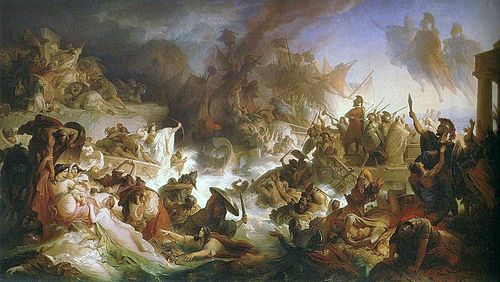
Battle of Salamis (Die Seeschlacht bei Salamis). Artemisia appears highlighted center-left of the painting, above the victorious Greek fleet, below the throne of Xerxes, and shooting arrows at the Greeks. Wilhelm von Kaulbach.